#include <juce_AudioProcessorParameter.h>
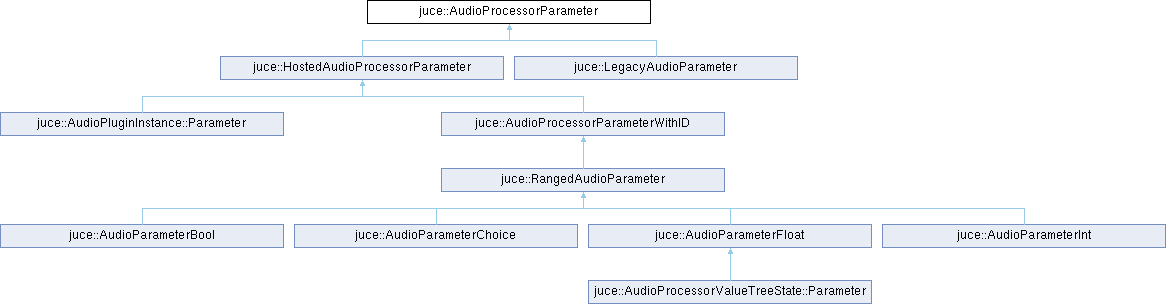
Classes | |
| class | Listener |
Public Types | |
| enum | Category { genericParameter = (0 << 16) | 0 , inputGain = (1 << 16) | 0 , outputGain = (1 << 16) | 1 , inputMeter = (2 << 16) | 0 , outputMeter = (2 << 16) | 1 , compressorLimiterGainReductionMeter = (2 << 16) | 2 , expanderGateGainReductionMeter = (2 << 16) | 3 , analysisMeter = (2 << 16) | 4 , otherMeter = (2 << 16) | 5 } |
Private Attributes | |
| AudioProcessor * | processor = nullptr |
| int | parameterIndex = -1 |
| int | version = 0 |
| CriticalSection | listenerLock |
| Array< Listener * > | listeners |
| StringArray | valueStrings |
Friends | |
| class | AudioProcessor |
| class | LegacyAudioParameter |
Detailed Description
An abstract base class for parameter objects that can be added to an AudioProcessor.
- See also
- AudioProcessor::addParameter
@tags{Audio}
Member Enumeration Documentation
◆ Category
| enum juce::AudioProcessorParameter::Category |
Constructor & Destructor Documentation
◆ AudioProcessorParameter() [1/2]
|
defaultnoexcept |
◆ AudioProcessorParameter() [2/2]
|
inlineexplicit |
The version hint supplied to this constructor is used in Audio Unit plugins to aid ordering parameter identifiers when JUCE_FORCE_USE_LEGACY_PARAM_IDS is not enabled.
When adding a parameter that is not present in a previous version of the Audio Unit, you must ensure that the version hint supplied is a number higher than that of any parameter in any previous plugin version.
For example, in the first release of a plugin, every parameter was created with "1" as a version hint. If you add some parameters in the second release of the plugin, all of the new parameters should have "2" as a version hint. Additional parameters added in subsequent plugin versions should have "3", "4", and so forth, increasing monotonically.
Note that adding or removing parameters with a version hint that is lower than the maximum version hint of all parameters will break saved automation in some hosts, so be careful!
A version hint of "0" will be treated as though the version hint has not been set explicitly. When targeting the AU format, the version hint may be checked at runtime in debug builds to ensure that it has been set.
Rationale:
According to Apple's Documentation:
An audio unit parameter is uniquely identified by the combination of its scope, element, and ID.
However, Logic Pro and GarageBand have a known limitation that causes them to use parameter indices instead of IDs to identify parameters. The effect of this is that adding parameters to a later version of a plugin can break automation saved with an earlier version of the plugin if the indices of existing parameters are changed. It is always unsafe to remove parameters from an Audio Unit plugin that will be used in one of these hosts, because removing a parameter will always modify the indices of following parameters.
In order to work around this limitation, parameters in AUv2 plugins are sorted first by their version hint, and then by the hash of their string identifier. As long as the parameters from later versions of the plugin always have a version hint that is higher than the parameters from earlier versions of the plugin, recall of automation data will work as expected in Logic and GarageBand.
Note that we can't just use the JUCE parameter index directly in order to preserve ordering. This would require all new parameters to be added at the end of the parameter list, which would make it impossible to add parameters to existing parameter groups. It would also make it awkward to structure code sensibly, undoing all of the benefits of string-based parameter identifiers.
At time of writing, AUv3 plugins seem to be affected by the same issue, but there does not appear to be any API to control parameter indices in this format. Therefore, when building AUv3 plugins you must not add or remove parameters in subsequent plugin versions if you wish to support Logic and GarageBand.
◆ ~AudioProcessorParameter()
|
virtual |
Destructor.
Member Function Documentation
◆ addListener()
| void juce::AudioProcessorParameter::addListener | ( | AudioProcessorParameter::Listener * | newListener | ) |
Registers a listener to receive events when the parameter's state changes. If the listener is already registered, this will not register it again.
- See also
- removeListener
◆ beginChangeGesture()
| void juce::AudioProcessorParameter::beginChangeGesture | ( | ) |
Sends a signal to the host to tell it that the user is about to start changing this parameter. This allows the host to know when a parameter is actively being held by the user, and it may use this information to help it record automation. If you call this, it must be matched by a later call to endChangeGesture().
◆ endChangeGesture()
| void juce::AudioProcessorParameter::endChangeGesture | ( | ) |
Tells the host that the user has finished changing this parameter. This allows the host to know when a parameter is actively being held by the user, and it may use this information to help it record automation. A call to this method must follow a call to beginChangeGesture().
◆ getAllValueStrings()
|
virtual |
Returns the set of strings which represent the possible states a parameter can be in.
If you are hosting a plug-in you can use the result of this function to populate a ComboBox listing the allowed values.
If you are implementing a plug-in then you do not need to override this.
◆ getCategory()
|
virtual |
Returns the parameter's category.
Reimplemented in juce::AudioProcessorParameterWithID, and juce::LegacyAudioParameter.
◆ getCurrentValueAsText()
|
virtual |
Returns the current value of the parameter as a String.
This function can be called when you are hosting plug-ins to get a more specialised textual representation of the current value from the plug-in, for example "On" rather than "1.0".
If you are implementing a plug-in then you should ignore this function and instead override getText.
Reimplemented in juce::LegacyAudioParameter.
◆ getDefaultValue()
|
pure virtual |
This should return the default value for this parameter.
Implemented in juce::AudioParameterBool, juce::AudioParameterChoice, juce::AudioParameterFloat, juce::AudioParameterInt, juce::AudioProcessorValueTreeState::Parameter, and juce::LegacyAudioParameter.
◆ getLabel()
|
pure virtual |
Some parameters may be able to return a label string for their units. For example "Hz" or "%".
Implemented in juce::AudioProcessorParameterWithID, and juce::LegacyAudioParameter.
◆ getName()
Returns the name to display for this parameter, which should be made to fit within the given string length.
Implemented in juce::AudioProcessorParameterWithID, and juce::LegacyAudioParameter.
◆ getNumSteps()
|
virtual |
Returns the number of steps that this parameter's range should be quantised into.
If you want a continuous range of values, don't override this method, and allow the default implementation to return AudioProcessor::getDefaultNumParameterSteps().
If your parameter is boolean, then you may want to make this return 2.
The value that is returned may or may not be used, depending on the host. If you want the host to display stepped automation values, rather than a continuous interpolation between successive values, you should override isDiscrete to return true.
- See also
- isDiscrete
Reimplemented in juce::AudioParameterBool, juce::AudioParameterChoice, juce::AudioParameterFloat, juce::AudioParameterInt, juce::AudioProcessorValueTreeState::Parameter, juce::LegacyAudioParameter, and juce::RangedAudioParameter.
◆ getParameterIndex()
|
inlinenoexcept |
Returns the index of this parameter in its parent processor's parameter list.
◆ getText()
Returns a textual version of the supplied normalised parameter value. The default implementation just returns the floating point value as a string, but this could do anything you need for a custom type of value.
Reimplemented in juce::AudioParameterBool, juce::AudioParameterChoice, juce::AudioParameterFloat, juce::AudioParameterInt, juce::AudioPluginInstance::Parameter, and juce::LegacyAudioParameter.
◆ getValue()
|
pure virtual |
Called by the host to find out the value of this parameter.
Hosts will expect the value returned to be between 0 and 1.0.
This could be called quite frequently, so try to make your code efficient. It's also likely to be called by non-UI threads, so the code in here should be thread-aware.
Implemented in juce::AudioParameterBool, juce::AudioParameterChoice, juce::AudioParameterFloat, juce::AudioParameterInt, and juce::LegacyAudioParameter.
◆ getValueForText()
|
pure virtual |
Should parse a string and return the appropriate value for it.
Implemented in juce::AudioParameterBool, juce::AudioParameterChoice, juce::AudioParameterFloat, juce::AudioParameterInt, juce::AudioPluginInstance::Parameter, and juce::LegacyAudioParameter.
◆ getVersionHint()
|
inline |
- See also
- AudioProcessorParameter(int)
◆ isAutomatable()
|
virtual |
Returns true if the host can automate this parameter. By default, this returns true.
Reimplemented in juce::AudioProcessorParameterWithID, and juce::LegacyAudioParameter.
◆ isBoolean()
|
virtual |
Returns whether the parameter represents a boolean switch, typically with "On" and "Off" states.
This information may or may not be used, depending on the host. If you want the host to display a switch, rather than a two item dropdown menu, override this method to return true. You also need to override isDiscrete() to return true and getNumSteps() to return 2.
- See also
- isDiscrete getNumSteps
Reimplemented in juce::AudioParameterBool, juce::AudioProcessorValueTreeState::Parameter, and juce::LegacyAudioParameter.
◆ isDiscrete()
|
virtual |
Returns whether the parameter uses discrete values, based on the result of getNumSteps, or allows the host to select values continuously.
This information may or may not be used, depending on the host. If you want the host to display stepped automation values, rather than a continuous interpolation between successive values, override this method to return true.
- See also
- getNumSteps
Reimplemented in juce::AudioParameterBool, juce::AudioParameterChoice, juce::AudioProcessorValueTreeState::Parameter, and juce::LegacyAudioParameter.
◆ isMetaParameter()
|
virtual |
Should return true if this parameter is a "meta" parameter. A meta-parameter is a parameter that changes other params. It is used by some hosts (e.g. AudioUnit hosts). By default this returns false.
Reimplemented in juce::AudioProcessorParameterWithID, and juce::LegacyAudioParameter.
◆ isOrientationInverted()
|
virtual |
This can be overridden to tell the host that this parameter operates in the reverse direction. (Not all plugin formats or hosts will actually use this information).
Reimplemented in juce::AudioProcessorParameterWithID, and juce::LegacyAudioParameter.
◆ removeListener()
| void juce::AudioProcessorParameter::removeListener | ( | AudioProcessorParameter::Listener * | listenerToRemove | ) |
Removes a previously registered parameter listener
- See also
- addListener
◆ sendValueChangedMessageToListeners()
| void juce::AudioProcessorParameter::sendValueChangedMessageToListeners | ( | float | newValue | ) |
◆ setValue()
|
pure virtual |
The host will call this method to change the value of a parameter.
The host may call this at any time, including during the audio processing callback, so your implementation has to process this very efficiently and avoid any kind of locking.
If you want to set the value of a parameter internally, e.g. from your editor component, then don't call this directly - instead, use the setValueNotifyingHost() method, which will also send a message to the host telling it about the change. If the message isn't sent, the host won't be able to automate your parameters properly.
The value passed will be between 0 and 1.0.
Implemented in juce::AudioParameterBool, juce::AudioParameterChoice, juce::AudioParameterFloat, juce::AudioParameterInt, and juce::LegacyAudioParameter.
◆ setValueNotifyingHost()
| void juce::AudioProcessorParameter::setValueNotifyingHost | ( | float | newValue | ) |
A processor should call this when it needs to change one of its parameters.
This could happen when the editor or some other internal operation changes a parameter. This method will call the setValue() method to change the value, and will then send a message to the host telling it about the change.
Note that to make sure the host correctly handles automation, you should call the beginChangeGesture() and endChangeGesture() methods to tell the host when the user has started and stopped changing the parameter.
Friends And Related Symbol Documentation
◆ AudioProcessor
|
friend |
◆ LegacyAudioParameter
|
friend |
Member Data Documentation
◆ listenerLock
|
private |
◆ listeners
◆ parameterIndex
|
private |
◆ processor
|
private |
◆ valueStrings
|
mutableprivate |
◆ version
|
private |
The documentation for this class was generated from the following files:
- /home/runner/work/lmms-fork/lmms-fork/plugins/CarlaBase/carla/source/modules/juce_audio_processors/processors/juce_AudioProcessorParameter.h
- /home/runner/work/lmms-fork/lmms-fork/plugins/CarlaBase/carla/source/modules/juce_audio_processors/processors/juce_AudioProcessor.cpp
Generated on for LMMS by
 1.16.1