#include <juce_AudioParameterBool.h>
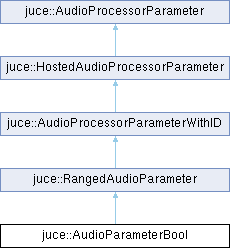
Protected Member Functions | |
| virtual void | valueChanged (bool newValue) |
Private Member Functions | |
| float | getValue () const override |
| void | setValue (float newValue) override |
| float | getDefaultValue () const override |
| int | getNumSteps () const override |
| bool | isDiscrete () const override |
| bool | isBoolean () const override |
| String | getText (float, int) const override |
| float | getValueForText (const String &) const override |
Private Attributes | |
| const NormalisableRange< float > | range { 0.0f, 1.0f, 1.0f } |
| std::atomic< float > | value |
| const float | valueDefault |
| std::function< String(bool, int)> | stringFromBoolFunction |
| std::function< bool(const String &)> | boolFromStringFunction |
Additional Inherited Members | |
| Public Types inherited from juce::AudioProcessorParameter | |
| enum | Category { genericParameter = (0 << 16) | 0 , inputGain = (1 << 16) | 0 , outputGain = (1 << 16) | 1 , inputMeter = (2 << 16) | 0 , outputMeter = (2 << 16) | 1 , compressorLimiterGainReductionMeter = (2 << 16) | 2 , expanderGateGainReductionMeter = (2 << 16) | 3 , analysisMeter = (2 << 16) | 4 , otherMeter = (2 << 16) | 5 } |
| Public Attributes inherited from juce::AudioProcessorParameterWithID | |
| const String | paramID |
| const String | name |
| const String | label |
| const Category | category |
Detailed Description
Provides a class of AudioProcessorParameter that can be used as a boolean value.
@tags{Audio}
Constructor & Destructor Documentation
◆ AudioParameterBool() [1/2]
| juce::AudioParameterBool::AudioParameterBool | ( | const ParameterID & | parameterID, |
| const String & | parameterName, | ||
| bool | defaultValue, | ||
| const AudioParameterBoolAttributes & | attributes = {} ) |
Creates a AudioParameterBool with the specified parameters.
Note that the attributes argument is optional and only needs to be supplied if you want to change options from their default values.
Example usage:
- Parameters
-
parameterID The parameter ID to use parameterName The parameter name to use defaultValue The default value Attributes Optional characteristics
◆ AudioParameterBool() [2/2]
|
inline |
Creates a AudioParameterBool with the specified parameters.
- Parameters
-
parameterID The parameter ID to use parameterName The parameter name to use defaultValue The default value parameterLabel An optional label for the parameter's value stringFromBool An optional lambda function that converts a bool value to a string with a maximum length. This may be used by hosts to display the parameter's value. boolFromString An optional lambda function that parses a string and converts it into a bool value. Some hosts use this to allow users to type in parameter values.
◆ ~AudioParameterBool()
|
override |
Destructor.
Member Function Documentation
◆ get()
|
inlinenoexcept |
Returns the parameter's current boolean value.
◆ getDefaultValue()
|
overrideprivatevirtual |
This should return the default value for this parameter.
Implements juce::AudioProcessorParameter.
◆ getNormalisableRange()
|
inlineoverridevirtual |
Returns the range of values that the parameter can take.
Implements juce::RangedAudioParameter.
◆ getNumSteps()
|
overrideprivatevirtual |
Returns the number of steps that this parameter's range should be quantised into.
If you want a continuous range of values, don't override this method, and allow the default implementation to return AudioProcessor::getDefaultNumParameterSteps().
If your parameter is boolean, then you may want to make this return 2.
The value that is returned may or may not be used, depending on the host. If you want the host to display stepped automation values, rather than a continuous interpolation between successive values, you should override isDiscrete to return true.
- See also
- isDiscrete
Reimplemented from juce::AudioProcessorParameter.
◆ getText()
|
overrideprivatevirtual |
Returns a textual version of the supplied normalised parameter value. The default implementation just returns the floating point value as a string, but this could do anything you need for a custom type of value.
Reimplemented from juce::AudioProcessorParameter.
◆ getValue()
|
overrideprivatevirtual |
Called by the host to find out the value of this parameter.
Hosts will expect the value returned to be between 0 and 1.0.
This could be called quite frequently, so try to make your code efficient. It's also likely to be called by non-UI threads, so the code in here should be thread-aware.
Implements juce::AudioProcessorParameter.
◆ getValueForText()
Should parse a string and return the appropriate value for it.
Implements juce::AudioProcessorParameter.
◆ isBoolean()
|
overrideprivatevirtual |
Returns whether the parameter represents a boolean switch, typically with "On" and "Off" states.
This information may or may not be used, depending on the host. If you want the host to display a switch, rather than a two item dropdown menu, override this method to return true. You also need to override isDiscrete() to return true and getNumSteps() to return 2.
- See also
- isDiscrete getNumSteps
Reimplemented from juce::AudioProcessorParameter.
◆ isDiscrete()
|
overrideprivatevirtual |
Returns whether the parameter uses discrete values, based on the result of getNumSteps, or allows the host to select values continuously.
This information may or may not be used, depending on the host. If you want the host to display stepped automation values, rather than a continuous interpolation between successive values, override this method to return true.
- See also
- getNumSteps
Reimplemented from juce::AudioProcessorParameter.
◆ operator bool()
|
inlinenoexcept |
Returns the parameter's current boolean value.
◆ operator=()
| AudioParameterBool & juce::AudioParameterBool::operator= | ( | bool | newValue | ) |
Changes the parameter's current value to a new boolean.
◆ setValue()
|
overrideprivatevirtual |
The host will call this method to change the value of a parameter.
The host may call this at any time, including during the audio processing callback, so your implementation has to process this very efficiently and avoid any kind of locking.
If you want to set the value of a parameter internally, e.g. from your editor component, then don't call this directly - instead, use the setValueNotifyingHost() method, which will also send a message to the host telling it about the change. If the message isn't sent, the host won't be able to automate your parameters properly.
The value passed will be between 0 and 1.0.
Implements juce::AudioProcessorParameter.
◆ valueChanged()
|
protectedvirtual |
Override this method if you are interested in receiving callbacks when the parameter value changes.
Member Data Documentation
◆ boolFromStringFunction
◆ range
|
private |
◆ stringFromBoolFunction
◆ value
|
private |
◆ valueDefault
|
private |
The documentation for this class was generated from the following files:
- /home/runner/work/lmms-fork/lmms-fork/plugins/CarlaBase/carla/source/modules/juce_audio_processors/utilities/juce_AudioParameterBool.h
- /home/runner/work/lmms-fork/lmms-fork/plugins/CarlaBase/carla/source/modules/juce_audio_processors/utilities/juce_AudioParameterBool.cpp
Generated on for LMMS by
 1.16.1