#include <juce_RangedAudioParameter.h>
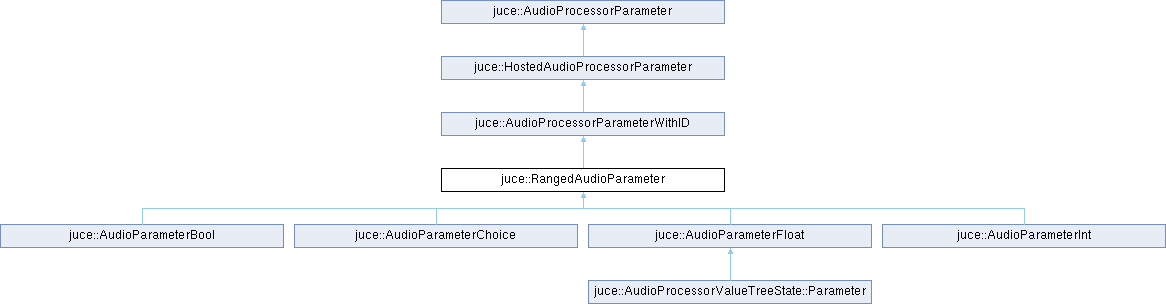
Additional Inherited Members | |
| Public Types inherited from juce::AudioProcessorParameter | |
| enum | Category { genericParameter = (0 << 16) | 0 , inputGain = (1 << 16) | 0 , outputGain = (1 << 16) | 1 , inputMeter = (2 << 16) | 0 , outputMeter = (2 << 16) | 1 , compressorLimiterGainReductionMeter = (2 << 16) | 2 , expanderGateGainReductionMeter = (2 << 16) | 3 , analysisMeter = (2 << 16) | 4 , otherMeter = (2 << 16) | 5 } |
| Public Attributes inherited from juce::AudioProcessorParameterWithID | |
| const String | paramID |
| const String | name |
| const String | label |
| const Category | category |
Detailed Description
This abstract base class is used by some AudioProcessorParameter helper classes.
@tags{Audio}
Member Function Documentation
◆ AudioProcessorParameterWithID() [1/2]
| juce::AudioProcessorParameterWithID::AudioProcessorParameterWithID | ( | const ParameterID & | parameterID, |
| const String & | parameterName, | ||
| const AudioProcessorParameterWithIDAttributes & | attributes = {} ) |
The creation of this object requires providing a name and ID which will be constant for its lifetime.
Given that AudioProcessorParameterWithID is abstract, you'll probably call this constructor from a derived class constructor, e.g.
- Parameters
-
parameterID Specifies the identifier, and optionally the parameter's version hint. parameterName The user-facing parameter name. Attributes Other parameter properties.
◆ AudioProcessorParameterWithID() [2/2]
|
inline |
The creation of this object requires providing a name and ID which will be constant for its lifetime.
- Parameters
-
parameterID Used to uniquely identify the parameter parameterName The user-facing name of the parameter parameterLabel An optional label for the parameter's value parameterCategory The semantics of this parameter
◆ convertFrom0to1()
|
noexcept |
Denormalises and snaps a value based on the normalisable range.
◆ convertTo0to1()
|
noexcept |
Normalises and snaps a value based on the normalisable range.
◆ getNormalisableRange()
|
pure virtual |
Returns the range of values that the parameter can take.
Implemented in juce::AudioParameterBool, juce::AudioParameterChoice, juce::AudioParameterFloat, and juce::AudioParameterInt.
◆ getNumSteps()
|
overridevirtual |
Returns the number of steps for this parameter based on the normalisable range's interval. If you are using lambda functions to define the normalisable range's snapping behaviour then you should override this function so that it returns the number of snapping points.
Reimplemented from juce::AudioProcessorParameter.
The documentation for this class was generated from the following files:
- /home/runner/work/lmms-fork/lmms-fork/plugins/CarlaBase/carla/source/modules/juce_audio_processors/utilities/juce_RangedAudioParameter.h
- /home/runner/work/lmms-fork/lmms-fork/plugins/CarlaBase/carla/source/modules/juce_audio_processors/utilities/juce_RangedAudioParameter.cpp
Generated on for LMMS by
 1.16.1