#include <juce_AudioProcessorParameterWithID.h>
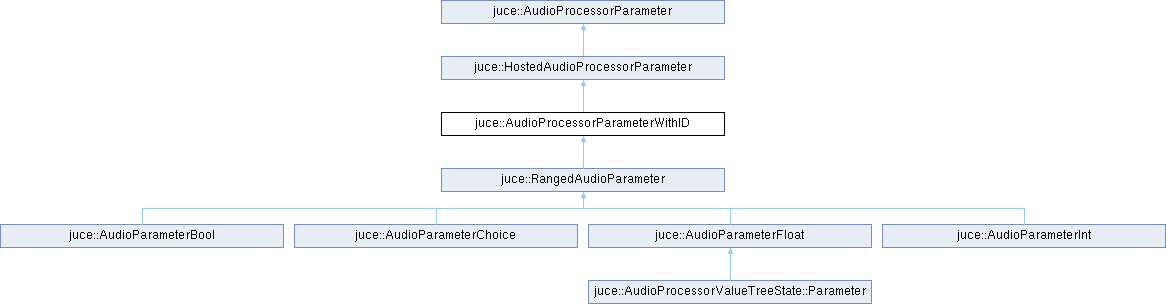
Public Attributes | |
| const String | paramID |
| const String | name |
| const String | label |
| const Category | category |
Private Attributes | |
| bool | meta = false |
| bool | automatable = true |
| bool | inverted = false |
Additional Inherited Members | |
| Public Types inherited from juce::AudioProcessorParameter | |
| enum | Category { genericParameter = (0 << 16) | 0 , inputGain = (1 << 16) | 0 , outputGain = (1 << 16) | 1 , inputMeter = (2 << 16) | 0 , outputMeter = (2 << 16) | 1 , compressorLimiterGainReductionMeter = (2 << 16) | 2 , expanderGateGainReductionMeter = (2 << 16) | 3 , analysisMeter = (2 << 16) | 4 , otherMeter = (2 << 16) | 5 } |
Detailed Description
This abstract base class is used by some AudioProcessorParameter helper classes.
@tags{Audio}
Constructor & Destructor Documentation
◆ AudioProcessorParameterWithID() [1/2]
| juce::AudioProcessorParameterWithID::AudioProcessorParameterWithID | ( | const ParameterID & | parameterID, |
| const String & | parameterName, | ||
| const AudioProcessorParameterWithIDAttributes & | attributes = {} ) |
The creation of this object requires providing a name and ID which will be constant for its lifetime.
Given that AudioProcessorParameterWithID is abstract, you'll probably call this constructor from a derived class constructor, e.g.
- Parameters
-
parameterID Specifies the identifier, and optionally the parameter's version hint. parameterName The user-facing parameter name. Attributes Other parameter properties.
◆ AudioProcessorParameterWithID() [2/2]
|
inline |
The creation of this object requires providing a name and ID which will be constant for its lifetime.
- Parameters
-
parameterID Used to uniquely identify the parameter parameterName The user-facing name of the parameter parameterLabel An optional label for the parameter's value parameterCategory The semantics of this parameter
Member Function Documentation
◆ getCategory()
|
overridevirtual |
Returns the parameter's category.
Reimplemented from juce::AudioProcessorParameter.
◆ getLabel()
|
overridevirtual |
Some parameters may be able to return a label string for their units. For example "Hz" or "%".
Implements juce::AudioProcessorParameter.
◆ getName()
|
overridevirtual |
Returns the name to display for this parameter, which should be made to fit within the given string length.
Implements juce::AudioProcessorParameter.
◆ getParameterID()
|
inlineoverridevirtual |
Returns an ID that is unique to this parameter.
Parameter indices are unstable across plugin versions, which means that the parameter found at a particular index in one version of a plugin might move to a different index in the subsequent version.
Unlike the parameter index, the ID returned by this function should be somewhat stable (depending on the format of the plugin), so it is more suitable for storing/recalling automation data.
Implements juce::HostedAudioProcessorParameter.
◆ isAutomatable()
|
inlineoverridevirtual |
Returns true if the host can automate this parameter. By default, this returns true.
Reimplemented from juce::AudioProcessorParameter.
◆ isMetaParameter()
|
inlineoverridevirtual |
Should return true if this parameter is a "meta" parameter. A meta-parameter is a parameter that changes other params. It is used by some hosts (e.g. AudioUnit hosts). By default this returns false.
Reimplemented from juce::AudioProcessorParameter.
◆ isOrientationInverted()
|
inlineoverridevirtual |
This can be overridden to tell the host that this parameter operates in the reverse direction. (Not all plugin formats or hosts will actually use this information).
Reimplemented from juce::AudioProcessorParameter.
Member Data Documentation
◆ automatable
|
private |
◆ category
Provides access to the parameter's category.
◆ inverted
|
private |
◆ label
◆ meta
|
private |
◆ name
◆ paramID
Provides access to the parameter's ID string.
The documentation for this class was generated from the following files:
- /home/runner/work/lmms-fork/lmms-fork/plugins/CarlaBase/carla/source/modules/juce_audio_processors/utilities/juce_AudioProcessorParameterWithID.h
- /home/runner/work/lmms-fork/lmms-fork/plugins/CarlaBase/carla/source/modules/juce_audio_processors/utilities/juce_AudioProcessorParameterWithID.cpp
Generated on for LMMS by
 1.16.1