#include <juce_TableHeaderComponent.h>
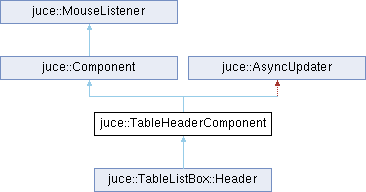
Classes | |
| class | Listener |
| struct | LookAndFeelMethods |
| struct | ColumnInfo |
| class | DragOverlayComp |
Public Types | |
| enum | ColumnPropertyFlags { visible = 1 , resizable = 2 , draggable = 4 , appearsOnColumnMenu = 8 , sortable = 16 , sortedForwards = 32 , sortedBackwards = 64 , defaultFlags = (visible | resizable | draggable | appearsOnColumnMenu | sortable) , notResizable = (visible | draggable | appearsOnColumnMenu | sortable) , notResizableOrSortable = (visible | draggable | appearsOnColumnMenu) , notSortable = (visible | resizable | draggable | appearsOnColumnMenu) } |
| enum | ColourIds { textColourId = 0x1003800 , backgroundColourId = 0x1003810 , outlineColourId = 0x1003820 , highlightColourId = 0x1003830 } |
| Public Types inherited from juce::Component | |
| enum class | FocusContainerType { none , focusContainer , keyboardFocusContainer } |
| enum | FocusChangeType { focusChangedByMouseClick , focusChangedByTabKey , focusChangedDirectly } |
Private Member Functions | |
| std::unique_ptr< AccessibilityHandler > | createAccessibilityHandler () override |
| ColumnInfo * | getInfoForId (int columnId) const |
| int | visibleIndexToTotalIndex (int visibleIndex) const |
| void | sendColumnsChanged () |
| void | handleAsyncUpdate () override |
| void | beginDrag (const MouseEvent &) |
| void | endDrag (int finalIndex) |
| int | getResizeDraggerAt (int mouseX) const |
| void | updateColumnUnderMouse (const MouseEvent &) |
| void | setColumnUnderMouse (int columnId) |
| void | resizeColumnsToFit (int firstColumnIndex, int targetTotalWidth) |
| Private Member Functions inherited from juce::AsyncUpdater | |
| AsyncUpdater () | |
| virtual | ~AsyncUpdater () |
| void | triggerAsyncUpdate () |
| void | cancelPendingUpdate () noexcept |
| void | handleUpdateNowIfNeeded () |
| bool | isUpdatePending () const noexcept |
Private Attributes | |
| OwnedArray< ColumnInfo > | columns |
| Array< Listener * > | listeners |
| std::unique_ptr< Component > | dragOverlayComp |
| bool | columnsChanged = false |
| bool | columnsResized = false |
| bool | sortChanged = false |
| bool | menuActive = true |
| bool | stretchToFit = false |
| int | columnIdBeingResized = 0 |
| int | columnIdBeingDragged = 0 |
| int | initialColumnWidth = 0 |
| int | columnIdUnderMouse = 0 |
| int | draggingColumnOffset = 0 |
| int | draggingColumnOriginalIndex = 0 |
| int | lastDeliberateWidth = 0 |
Additional Inherited Members | |
| Static Public Member Functions inherited from juce::Component | |
| static float JUCE_CALLTYPE | getApproximateScaleFactorForComponent (const Component *targetComponent) |
| static Component *JUCE_CALLTYPE | getCurrentlyFocusedComponent () noexcept |
| static void JUCE_CALLTYPE | unfocusAllComponents () |
| static void JUCE_CALLTYPE | beginDragAutoRepeat (int millisecondsBetweenCallbacks) |
| static bool JUCE_CALLTYPE | isMouseButtonDownAnywhere () noexcept |
| static int JUCE_CALLTYPE | getNumCurrentlyModalComponents () noexcept |
| static Component *JUCE_CALLTYPE | getCurrentlyModalComponent (int index=0) noexcept |
| Protected Member Functions inherited from juce::Component | |
| virtual ComponentPeer * | createNewPeer (int styleFlags, void *nativeWindowToAttachTo) |
| Static Protected Member Functions inherited from juce::Component | |
| static std::unique_ptr< AccessibilityHandler > | createIgnoredAccessibilityHandler (Component &) |
Detailed Description
A component that displays a strip of column headings for a table, and allows these to be resized, dragged around, etc.
This is just the component that goes at the top of a table. You can use it directly for custom components, or to create a simple table, use the TableListBox class.
To use one of these, create it and use addColumn() to add all the columns that you need. Each column must be given a unique ID number that's used to refer to it.
@tags{GUI}
Member Enumeration Documentation
◆ ColourIds
| enum juce::TableHeaderComponent::ColourIds |
A set of colour IDs to use to change the colour of various aspects of the TableHeaderComponent.
- See also
- Component::setColour, Component::findColour, LookAndFeel::setColour, LookAndFeel::findColour
| Enumerator | |
|---|---|
| textColourId | The colour for the text in the header. |
| backgroundColourId | The colour of the table header background. It's up to the LookAndFeel how this is used. |
| outlineColourId | The colour of the table header's outline. |
| highlightColourId | The colour of the table header background when the mouse is over or down above the the table header. It's up to the LookAndFeel to use a variant of this colour to distinguish between the down and hover state. |
◆ ColumnPropertyFlags
| enum juce::TableHeaderComponent::ColumnPropertyFlags |
A combination of these flags are passed into the addColumn() method to specify the properties of a column.
Constructor & Destructor Documentation
◆ TableHeaderComponent()
| juce::TableHeaderComponent::TableHeaderComponent | ( | ) |
Creates an empty table header.
◆ ~TableHeaderComponent()
|
override |
Destructor.
Member Function Documentation
◆ addColumn()
| void juce::TableHeaderComponent::addColumn | ( | const String & | columnName, |
| int | columnId, | ||
| int | width, | ||
| int | minimumWidth = 30, | ||
| int | maximumWidth = -1, | ||
| int | propertyFlags = defaultFlags, | ||
| int | insertIndex = -1 ) |
Adds a column to the table.
This will add a column, and asynchronously call the tableColumnsChanged() method of any registered listeners.
- Parameters
-
columnName the name of the new column. It's ok to have two or more columns with the same name columnId an ID for this column. The ID can be any number apart from 0, but every column must have a unique ID. This is used to identify the column later on, after the user may have changed the order that they appear in width the initial width of the column, in pixels maximumWidth a maximum width that the column can take when the user is resizing it. This only applies if the 'resizable' flag is specified for this column minimumWidth a minimum width that the column can take when the user is resizing it. This only applies if the 'resizable' flag is specified for this column propertyFlags a combination of some of the values from the ColumnPropertyFlags enum, to define the properties of this column insertIndex the index at which the column should be added. A value of 0 puts it at the start (left-hand side) and -1 puts it at the end (right-hand size) of the table. Note that the index the index within all columns, not just the index amongst those that are currently visible
◆ addListener()
Adds a listener to be informed about things that happen to the header.
◆ addMenuItems()
This can be overridden to add custom items to the pop-up menu.
If you override this, you should call the superclass's method to add its column show/hide items, if you want them on the menu as well.
Then to handle the result, override reactToMenuItem().
- See also
- reactToMenuItem
Reimplemented in juce::TableListBox::Header.
◆ beginDrag()
|
private |
◆ columnClicked()
|
virtual |
This can be overridden to handle a mouse-click on one of the column headers.
The default implementation will use this click to call getSortColumnId() and change the sort order.
◆ createAccessibilityHandler()
|
overrideprivatevirtual |
Override this method to return a custom AccessibilityHandler for this component.
The default implementation creates and returns a AccessibilityHandler object with an unspecified role, meaning that it will be visible to accessibility clients but without a specific role, action callbacks or interfaces. To control how accessibility clients see and interact with your component subclass AccessibilityHandler, implement the desired behaviours, and return an instance of it from this method in your component subclass.
The accessibility handler you return here is guaranteed to be destroyed before its Component, so it's safe to store and use a reference back to the Component inside the AccessibilityHandler if necessary.
- See also
- getAccessibilityHandler
Reimplemented from juce::Component.
◆ endDrag()
◆ getColumnIdAtX()
Finds the column ID at a given x-position in the component. If there is a column at this point this returns its ID, or if not, it will return 0.
◆ getColumnIdOfIndex()
| int juce::TableHeaderComponent::getColumnIdOfIndex | ( | int | index, |
| bool | onlyCountVisibleColumns ) const |
Returns the ID of the column at a given index.
If onlyCountVisibleColumns is true, this will count the index amongst the visible columns; otherwise it'll count it amongst all the columns, including any hidden ones.
If the index is out-of-range, it'll return 0.
◆ getColumnName()
Returns the name for a column.
- See also
- setColumnName
◆ getColumnPosition()
Returns the rectangle containing of one of the columns.
The index is an index from 0 to the number of columns that are currently visible (hidden ones are not counted). It returns a rectangle showing the position of the column relative to this component's top-left. If the index is out-of-range, an empty rectangle is returned.
◆ getColumnWidth()
Returns the width of one of the columns.
◆ getIndexOfColumnId()
| int juce::TableHeaderComponent::getIndexOfColumnId | ( | int | columnId, |
| bool | onlyCountVisibleColumns ) const |
Returns the index of a given column.
If there's no such column ID, this will return -1.
If onlyCountVisibleColumns is true, this will return the index amongst the visible columns; otherwise it'll return the index amongst all the columns, including any hidden ones.
◆ getInfoForId()
|
private |
◆ getMouseCursor()
|
overridevirtual |
Returns the mouse cursor shape to use when the mouse is over this component.
The default implementation will return the cursor that was set by setCursor() but can be overridden for more specialised purposes, e.g. returning different cursors depending on the mouse position.
- See also
- MouseCursor
Reimplemented from juce::Component.
◆ getNumColumns()
| int juce::TableHeaderComponent::getNumColumns | ( | bool | onlyCountVisibleColumns | ) | const |
Returns the number of columns in the table.
If onlyCountVisibleColumns is true, this will return the number of visible columns; otherwise it'll return the total number of columns, including hidden ones.
- See also
- isColumnVisible
◆ getResizeDraggerAt()
◆ getSortColumnId()
| int juce::TableHeaderComponent::getSortColumnId | ( | ) | const |
Returns the column ID by which the table is currently sorted, or 0 if it is unsorted.
- See also
- setSortColumnId, isSortedForwards
◆ getTotalWidth()
| int juce::TableHeaderComponent::getTotalWidth | ( | ) | const |
Returns the total width of all the visible columns in the table.
◆ handleAsyncUpdate()
|
overrideprivatevirtual |
Called back to do whatever your class needs to do.
This method is called by the message thread at the next convenient time after the triggerAsyncUpdate() method has been called.
Implements juce::AsyncUpdater.
◆ isColumnVisible()
| bool juce::TableHeaderComponent::isColumnVisible | ( | int | columnId | ) | const |
Returns true if this column is currently visible.
- See also
- setColumnVisible
◆ isPopupMenuActive()
| bool juce::TableHeaderComponent::isPopupMenuActive | ( | ) | const |
Returns true if the pop-up menu is enabled.
- See also
- setPopupMenuActive
◆ isSortedForwards()
| bool juce::TableHeaderComponent::isSortedForwards | ( | ) | const |
Returns true if the table is currently sorted forwards, or false if it's backwards.
- See also
- setSortColumnId
◆ isStretchToFitActive()
| bool juce::TableHeaderComponent::isStretchToFitActive | ( | ) | const |
Returns true if stretch-to-fit has been enabled.
- See also
- setStretchToFitActive
◆ mouseDown()
|
overridevirtual |
Called when a mouse button is pressed.
The MouseEvent object passed in contains lots of methods for finding out which button was pressed, as well as which modifier keys (e.g. shift, ctrl) were held down at the time.
Once a button is held down, the mouseDrag method will be called when the mouse moves, until the button is released.
- Parameters
-
Event details about the position and status of the mouse event, including the source component in which it occurred
- See also
- mouseUp, mouseDrag, mouseDoubleClick, contains
Reimplemented from juce::Component.
◆ mouseDrag()
|
overridevirtual |
Called when the mouse is moved while a button is held down.
When a mouse button is pressed inside a component, that component receives mouseDrag callbacks each time the mouse moves, even if the mouse strays outside the component's bounds.
- Parameters
-
Event details about the position and status of the mouse event, including the source component in which it occurred
- See also
- mouseDown, mouseUp, mouseMove, contains, setDragRepeatInterval
Reimplemented from juce::Component.
◆ mouseEnter()
|
overridevirtual |
Called when the mouse first enters a component.
If the mouse button isn't pressed and the mouse moves into a component, this will be called to let the component react to this.
When the mouse button is pressed and held down while being moved in or out of a component, no mouseEnter or mouseExit callbacks are made - only mouseDrag messages are sent to the component that the mouse was originally clicked on, until the button is released.
- Parameters
-
Event details about the position and status of the mouse event, including the source component in which it occurred
- See also
- mouseExit, mouseDrag, mouseMove, contains
Reimplemented from juce::Component.
◆ mouseExit()
|
overridevirtual |
Called when the mouse moves out of a component.
This will be called when the mouse moves off the edge of this component.
If the mouse button was pressed, and it was then dragged off the edge of the component and released, then this callback will happen when the button is released, after the mouseUp callback.
- Parameters
-
Event details about the position and status of the mouse event, including the source component in which it occurred
- See also
- mouseEnter, mouseDrag, mouseMove, contains
Reimplemented from juce::Component.
◆ mouseMove()
|
overridevirtual |
Called when the mouse moves inside a component.
If the mouse button isn't pressed and the mouse moves over a component, this will be called to let the component react to this.
A component will always get a mouseEnter callback before a mouseMove.
- Parameters
-
Event details about the position and status of the mouse event, including the source component in which it occurred
- See also
- mouseEnter, mouseExit, mouseDrag, contains
Reimplemented from juce::Component.
◆ mouseUp()
|
overridevirtual |
Called when a mouse button is released.
A mouseUp callback is sent to the component in which a button was pressed even if the mouse is actually over a different component when the button is released.
The MouseEvent object passed in contains lots of methods for finding out which buttons were down just before they were released.
- Parameters
-
Event details about the position and status of the mouse event, including the source component in which it occurred
- See also
- mouseDown, mouseDrag, mouseDoubleClick, contains
Reimplemented from juce::Component.
◆ moveColumn()
Moves a column to a different index in the table.
- Parameters
-
columnId the column to move newVisibleIndex the target index for it, from 0 to the number of columns currently visible.
◆ paint()
Components can override this method to draw their content.
The paint() method gets called when a region of a component needs redrawing, either because the component's repaint() method has been called, or because something has happened on the screen that means a section of a window needs to be redrawn.
Any child components will draw themselves over whatever this method draws. If you need to paint over the top of your child components, you can also implement the paintOverChildren() method to do this.
If you want to cause a component to redraw itself, this is done asynchronously - calling the repaint() method marks a region of the component as "dirty", and the paint() method will automatically be called sometime later, by the message thread, to paint any bits that need refreshing. In JUCE (and almost all modern UI frameworks), you never redraw something synchronously.
You should never need to call this method directly - to take a snapshot of the component you could use createComponentSnapshot() or paintEntireComponent().
- Parameters
-
g the graphics context that must be used to do the drawing operations.
- See also
- repaint, paintOverChildren, Graphics
Reimplemented from juce::Component.
◆ reactToMenuItem()
Override this to handle any custom items that you have added to the pop-up menu with an addMenuItems() override.
If the menuReturnId isn't one of your own custom menu items, you'll need to call TableHeaderComponent::reactToMenuItem() to allow the base class to handle the items that it had added.
- See also
- addMenuItems
Reimplemented in juce::TableListBox::Header.
◆ removeAllColumns()
| void juce::TableHeaderComponent::removeAllColumns | ( | ) |
Deletes all columns from the table.
If there are any columns to remove, this will asynchronously call the tableColumnsChanged() method of any registered listeners.
◆ removeColumn()
Removes a column with the given ID.
If there is such a column, this will asynchronously call the tableColumnsChanged() method of any registered listeners.
◆ removeListener()
Removes a previously-registered listener.
◆ resizeAllColumnsToFit()
If stretch-to-fit is enabled, this will resize all the columns to make them fit into the specified width, keeping their relative proportions the same.
If the minimum widths of the columns are too wide to fit into this space, it may actually end up wider.
◆ resizeColumnsToFit()
|
private |
◆ reSortTable()
| void juce::TableHeaderComponent::reSortTable | ( | ) |
Triggers a re-sort of the table according to the current sort-column.
If you modify the table's contents, you can call this to signal that the table needs to be re-sorted.
(This doesn't do any sorting synchronously - it just asynchronously sends a call to the tableSortOrderChanged() method of any listeners).
◆ restoreFromString()
Restores the state of the table, based on a string previously created with toString().
- See also
- toString
◆ sendColumnsChanged()
|
private |
◆ setColumnName()
Changes the name of a column.
◆ setColumnUnderMouse()
◆ setColumnVisible()
Shows or hides a column.
This can cause an asynchronous callback to the tableColumnsChanged() method of any registered listeners.
- See also
- isColumnVisible
◆ setColumnWidth()
Changes the width of a column.
This will cause an asynchronous callback to the tableColumnsResized() method of any registered listeners.
◆ setPopupMenuActive()
| void juce::TableHeaderComponent::setPopupMenuActive | ( | bool | hasMenu | ) |
Enables or disables the pop-up menu.
The default menu allows the user to show or hide columns. You can add custom items to this menu by overloading the addMenuItems() and reactToMenuItem() methods.
By default the menu is enabled.
- See also
- isPopupMenuActive, addMenuItems, reactToMenuItem
◆ setSortColumnId()
Changes the column which is the sort column.
This can cause an asynchronous callback to the tableSortOrderChanged() method of any registered listeners.
If this method doesn't actually change the column ID, then no re-sort will take place (you can call reSortTable() to force a re-sort to happen if you've modified the table's contents).
- See also
- getSortColumnId, isSortedForwards, reSortTable
◆ setStretchToFitActive()
| void juce::TableHeaderComponent::setStretchToFitActive | ( | bool | shouldStretchToFit | ) |
If set to true, this indicates that the columns should be expanded or shrunk to fill the entire width of the component.
By default this is disabled. Turning it on also means that when resizing a column, those on the right will be squashed to fit.
◆ showColumnChooserMenu()
Can be overridden for more control over the pop-up menu behaviour.
◆ toString()
| String juce::TableHeaderComponent::toString | ( | ) | const |
Returns a string that encapsulates the table's current layout.
This can be restored later using restoreFromString(). It saves the order of the columns, the currently-sorted column, and the widths.
- See also
- restoreFromString
◆ updateColumnUnderMouse()
|
private |
◆ visibleIndexToTotalIndex()
Member Data Documentation
◆ columnIdBeingDragged
|
private |
◆ columnIdBeingResized
|
private |
◆ columnIdUnderMouse
|
private |
◆ columns
|
private |
◆ columnsChanged
|
private |
◆ columnsResized
|
private |
◆ draggingColumnOffset
|
private |
◆ draggingColumnOriginalIndex
|
private |
◆ dragOverlayComp
|
private |
◆ initialColumnWidth
|
private |
◆ lastDeliberateWidth
|
private |
◆ listeners
◆ menuActive
|
private |
◆ sortChanged
|
private |
◆ stretchToFit
|
private |
The documentation for this class was generated from the following files:
- /home/runner/work/lmms-fork/lmms-fork/plugins/CarlaBase/carla/source/modules/juce_gui_basics/widgets/juce_TableHeaderComponent.h
- /home/runner/work/lmms-fork/lmms-fork/plugins/CarlaBase/carla/source/modules/juce_gui_basics/widgets/juce_TableHeaderComponent.cpp
Generated on for LMMS by
 1.16.1