#include <juce_AccessibilityHandler.h>
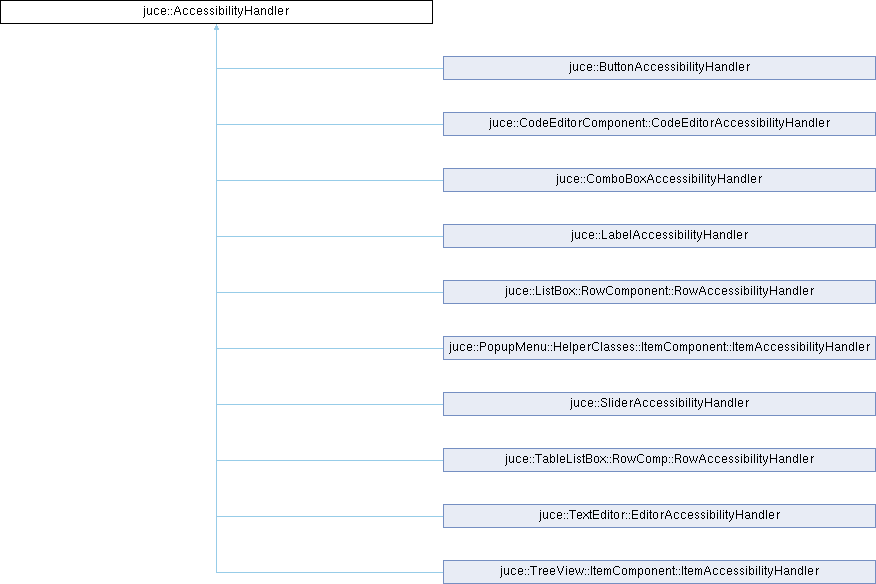
Classes | |
| struct | Interfaces |
| class | AccessibilityNativeImpl |
Public Types | |
| enum class | AnnouncementPriority { low , medium , high } |
Static Public Member Functions | |
| static void | postAnnouncement (const String &announcementString, AnnouncementPriority priority) |
Private Member Functions | |
| void | grabFocusInternal (bool) |
| void | giveAwayFocusInternal () const |
| void | takeFocus () |
Static Private Member Functions | |
| static std::unique_ptr< AccessibilityNativeImpl > | createNativeImpl (AccessibilityHandler &) |
Private Attributes | |
| Component & | component |
| std::type_index | typeIndex |
| const AccessibilityRole | role |
| AccessibilityActions | actions |
| Interfaces | interfaces |
| std::unique_ptr< AccessibilityNativeImpl > | nativeImpl |
Static Private Attributes | |
| static AccessibilityHandler * | currentlyFocusedHandler = nullptr |
Friends | |
| class | AccessibilityNativeHandle |
Detailed Description
Base class for accessible Components.
This class wraps a Component and provides methods that allow an accessibility client, such as VoiceOver on macOS, or Narrator on Windows, to control it.
It handles hierarchical navigation, properties, state, and various interfaces.
@tags{Accessibility}
Member Enumeration Documentation
◆ AnnouncementPriority
|
strong |
A priority level that can help an accessibility client determine how to handle an announcement request.
Exactly what this controls is platform-specific, but generally a low priority announcement will be read when the screen reader is free, whereas a high priority announcement will interrupt the current speech.
| Enumerator | |
|---|---|
| low | |
| medium | |
| high | |
Constructor & Destructor Documentation
◆ AccessibilityHandler()
| juce::AccessibilityHandler::AccessibilityHandler | ( | Component & | componentToWrap, |
| AccessibilityRole | accessibilityRole, | ||
| AccessibilityActions | actions = {}, | ||
| Interfaces | interfaces = {} ) |
Constructor.
This will create a AccessibilityHandler which wraps the provided Component and makes it visible to accessibility clients. You must also specify a role for the UI element from the AccessibilityRole list which best describes it.
To enable users to interact with the UI element you should provide the set of supported actions and their associated callbacks via the accessibilityActions parameter.
For UI elements that support more complex interaction the value, text, table, and cell interfaces should be implemented as required and passed as the final argument of this constructor. See the documentation of these classes for more information about the types of control they represent and which methods need to be implemented.
◆ ~AccessibilityHandler()
|
virtual |
Destructor.
Member Function Documentation
◆ createNativeImpl()
|
staticprivate |
◆ getActions()
|
noexcept |
Returns the set of actions that the UI element supports and the associated callbacks.
◆ getCellInterface()
| AccessibilityCellInterface * juce::AccessibilityHandler::getCellInterface | ( | ) | const |
Returns the cell interface for this UI element, or nullptr if it is not supported.
- See also
- AccessibilityCellInterface
◆ getChildAt()
| AccessibilityHandler * juce::AccessibilityHandler::getChildAt | ( | Point< int > | screenPoint | ) |
Returns the deepest child of this UI element in the accessibility hierarchy that contains the given screen point, or nullptr if there is no child at this point.
◆ getChildFocus()
| AccessibilityHandler * juce::AccessibilityHandler::getChildFocus | ( | ) |
Returns the deepest UI element which currently has focus.
This can be a child of this UI element or, if no child is focused, this element itself.
Note that this can be different to the value of the Component with keyboard focus returned by Component::getCurrentlyFocusedComponent().
- See also
- hasFocus
◆ getChildren()
| std::vector< AccessibilityHandler * > juce::AccessibilityHandler::getChildren | ( | ) | const |
Returns the unignored children of this UI element in the accessibility hierarchy.
◆ getComponent() [1/2]
Returns the Component that this handler represents.
◆ getComponent() [2/2]
|
inlinenoexcept |
Returns the Component that this handler represents.
◆ getCurrentState()
|
virtual |
Returns the current state of the UI element.
The default implementation of this method will set the focusable flag and, if this UI element is currently focused, will also set the focused flag.
Reimplemented in juce::ButtonAccessibilityHandler, juce::ComboBoxAccessibilityHandler, juce::LabelAccessibilityHandler, juce::ListBox::RowComponent::RowAccessibilityHandler, juce::PopupMenu::HelperClasses::ItemComponent::ItemAccessibilityHandler, juce::TableListBox::RowComp::RowAccessibilityHandler, and juce::TreeView::ItemComponent::ItemAccessibilityHandler.
◆ getDescription()
|
inlinevirtual |
A short description of the UI element.
This may be read out by the system. It should not include the type of the UI element and should ideally be a single word, for example "Open" for a button that opens a window.
The default implementation will call Component::getDescription(), but you can override this to return a different string if required.
If neither a name nor a description is provided then the UI element may be ignored by accessibility clients.
This must be a localised string.
◆ getHelp()
|
inlinevirtual |
Some help text for the UI element (if required).
This may be read out by the system. This string functions in a similar way to a tooltip, for example "Click to open window." for a button which opens a window.
The default implementation will call Component::getHelpText(), but you can override this to return a different string if required.
This must be a localised string.
Reimplemented in juce::ButtonAccessibilityHandler, juce::ComboBoxAccessibilityHandler, juce::LabelAccessibilityHandler, juce::ListBox::RowComponent::RowAccessibilityHandler, juce::SliderAccessibilityHandler, juce::TableListBox::RowComp::RowAccessibilityHandler, juce::TextEditor::EditorAccessibilityHandler, and juce::TreeView::ItemComponent::ItemAccessibilityHandler.
◆ getNativeImplementation()
| AccessibilityNativeHandle * juce::AccessibilityHandler::getNativeImplementation | ( | ) | const |
◆ getParent()
| AccessibilityHandler * juce::AccessibilityHandler::getParent | ( | ) | const |
Returns the first unignored parent of this UI element in the accessibility hierarchy, or nullptr if this is a root element without a parent.
◆ getRole()
|
inlinenoexcept |
The type of UI element that this accessibility handler represents.
- See also
- AccessibilityRole
◆ getTableInterface()
| AccessibilityTableInterface * juce::AccessibilityHandler::getTableInterface | ( | ) | const |
Returns the table interface for this UI element, or nullptr if it is not supported.
- See also
- AccessibilityTableInterface
◆ getTextInterface()
| AccessibilityTextInterface * juce::AccessibilityHandler::getTextInterface | ( | ) | const |
Returns the text interface for this UI element, or nullptr if it is not supported.
- See also
- AccessibilityTextInterface
◆ getTitle()
|
inlinevirtual |
The title of the UI element.
This will be read out by the system and should be concise, preferably matching the visible title of the UI element (if any). For example, this might be the text of a button or a simple label.
The default implementation will call Component::getTitle(), but you can override this to return a different string if required.
If neither a name nor a description is provided then the UI element may be ignored by accessibility clients.
This must be a localised string.
Reimplemented in juce::ButtonAccessibilityHandler, juce::ComboBoxAccessibilityHandler, juce::LabelAccessibilityHandler, juce::ListBox::RowComponent::RowAccessibilityHandler, juce::PopupMenu::HelperClasses::ItemComponent::ItemAccessibilityHandler, juce::TableListBox::RowComp::RowAccessibilityHandler, and juce::TreeView::ItemComponent::ItemAccessibilityHandler.
◆ getTypeIndex()
|
inline |
◆ getValueInterface()
| AccessibilityValueInterface * juce::AccessibilityHandler::getValueInterface | ( | ) | const |
Returns the value interface for this UI element, or nullptr if it is not supported.
- See also
- AccessibilityValueInterface
◆ giveAwayFocus()
| void juce::AccessibilityHandler::giveAwayFocus | ( | ) | const |
If this UI element or any of its children in the accessibility hierarchy currently have focus, this will defocus it.
This will also give away the keyboard focus from the Component it represents, and notify any listening accessibility clients that the current focus has changed.
- See also
- hasFocus, grabFocus
◆ giveAwayFocusInternal()
|
private |
◆ grabFocus()
| void juce::AccessibilityHandler::grabFocus | ( | ) |
Tries to give focus to this UI element.
If the UI element is focusable and not ignored this will update the currently focused element, try to give keyboard focus to the Component it represents, and notify any listening accessibility clients that the current focus has changed.
- See also
- hasFocus, giveAwayFocus
◆ grabFocusInternal()
|
private |
◆ hasFocus()
| bool juce::AccessibilityHandler::hasFocus | ( | bool | trueIfChildFocused | ) | const |
Returns true if this UI element has the focus.
- Parameters
-
trueIfChildFocused if this is true, this method will also return true if any child of this UI element in the accessibility hierarchy has focus
◆ isIgnored()
| bool juce::AccessibilityHandler::isIgnored | ( | ) | const |
Returns true if this UI element should be ignored by accessibility clients.
◆ isParentOf()
|
noexcept |
Checks whether a given UI element is a child of this one in the accessibility hierarchy.
◆ isVisibleWithinParent()
| bool juce::AccessibilityHandler::isVisibleWithinParent | ( | ) | const |
Returns true if this UI element is visible within its parent.
This will always return true for UI elements with the AccessibleState::accessibleOffscreen flag set.
◆ notifyAccessibilityEvent()
| void juce::AccessibilityHandler::notifyAccessibilityEvent | ( | AccessibilityEvent | event | ) | const |
Used to send a notification to any observing accessibility clients that something has changed in the UI element.
- See also
- AccessibilityEvent
◆ postAnnouncement()
|
static |
Posts an announcement to be made to the user.
- Parameters
-
announcementString a localised string containing the announcement to be read out priority the appropriate priority level for the announcement
◆ takeFocus()
|
private |
Friends And Related Symbol Documentation
◆ AccessibilityNativeHandle
|
friend |
Member Data Documentation
◆ actions
|
private |
◆ component
|
private |
◆ currentlyFocusedHandler
|
staticprivate |
◆ interfaces
|
private |
◆ nativeImpl
|
private |
◆ role
|
private |
◆ typeIndex
|
private |
The documentation for this class was generated from the following files:
- /home/runner/work/lmms-fork/lmms-fork/plugins/CarlaBase/carla/source/modules/juce_gui_basics/accessibility/juce_AccessibilityHandler.h
- /home/runner/work/lmms-fork/lmms-fork/plugins/CarlaBase/carla/source/modules/juce_gui_basics/accessibility/juce_AccessibilityHandler.cpp
- /home/runner/work/lmms-fork/lmms-fork/plugins/CarlaBase/carla/source/modules/juce_gui_basics/juce_gui_basics.cpp
- /home/runner/work/lmms-fork/lmms-fork/plugins/CarlaBase/carla/source/modules/juce_gui_basics/native/accessibility/juce_android_Accessibility.cpp
- /home/runner/work/lmms-fork/lmms-fork/plugins/CarlaBase/carla/source/modules/juce_gui_basics/native/accessibility/juce_win32_Accessibility.cpp
Generated on for LMMS by
 1.16.1