#include <juce_Button.h>
Classes | |
| class | Listener |
| struct | LookAndFeelMethods |
| struct | CallbackHelper |
Public Types | |
| enum | ConnectedEdgeFlags { ConnectedOnLeft = 1 , ConnectedOnRight = 2 , ConnectedOnTop = 4 , ConnectedOnBottom = 8 } |
| enum | ButtonState { buttonNormal , buttonOver , buttonDown } |
| Public Types inherited from juce::Component | |
| enum class | FocusContainerType { none , focusContainer , keyboardFocusContainer } |
| enum | FocusChangeType { focusChangedByMouseClick , focusChangedByTabKey , focusChangedDirectly } |
Public Attributes | |
| std::function< void()> | onClick |
| std::function< void()> | onStateChange |
Private Member Functions | |
| std::unique_ptr< AccessibilityHandler > | createAccessibilityHandler () override |
| void | checkToggleableState (bool wasToggleable) |
| void | repeatTimerCallback () |
| bool | keyStateChangedCallback () |
| void | applicationCommandListChangeCallback () |
| void | updateAutomaticTooltip (const ApplicationCommandInfo &) |
| ButtonState | updateState () |
| ButtonState | updateState (bool isOver, bool isDown) |
| bool | isShortcutPressed () const |
| void | turnOffOtherButtonsInGroup (NotificationType click, NotificationType state) |
| void | flashButtonState () |
| void | sendClickMessage (const ModifierKeys &) |
| void | sendStateMessage () |
| void | setToggleState (bool shouldBeOn, NotificationType click, NotificationType state) |
| bool | isMouseSourceOver (const MouseEvent &e) |
Private Attributes | |
| Array< KeyPress > | shortcuts |
| WeakReference< Component > | keySource |
| String | text |
| ListenerList< Listener > | buttonListeners |
| std::unique_ptr< CallbackHelper > | callbackHelper |
| uint32 | buttonPressTime = 0 |
| uint32 | lastRepeatTime = 0 |
| ApplicationCommandManager * | commandManagerToUse = nullptr |
| int | autoRepeatDelay = -1 |
| int | autoRepeatSpeed = 0 |
| int | autoRepeatMinimumDelay = -1 |
| int | radioGroupId = 0 |
| int | connectedEdgeFlags = 0 |
| CommandID | commandID = {} |
| ButtonState | buttonState = buttonNormal |
| ButtonState | lastStatePainted = buttonNormal |
| Value | isOn |
| bool | canBeToggled = false |
| bool | lastToggleState = false |
| bool | clickTogglesState = false |
| bool | needsToRelease = false |
| bool | needsRepainting = false |
| bool | isKeyDown = false |
| bool | triggerOnMouseDown = false |
| bool | generateTooltip = false |
Additional Inherited Members | |
| Static Public Member Functions inherited from juce::Component | |
| static float JUCE_CALLTYPE | getApproximateScaleFactorForComponent (const Component *targetComponent) |
| static Component *JUCE_CALLTYPE | getCurrentlyFocusedComponent () noexcept |
| static void JUCE_CALLTYPE | unfocusAllComponents () |
| static void JUCE_CALLTYPE | beginDragAutoRepeat (int millisecondsBetweenCallbacks) |
| static bool JUCE_CALLTYPE | isMouseButtonDownAnywhere () noexcept |
| static int JUCE_CALLTYPE | getNumCurrentlyModalComponents () noexcept |
| static Component *JUCE_CALLTYPE | getCurrentlyModalComponent (int index=0) noexcept |
| Static Protected Member Functions inherited from juce::Component | |
| static std::unique_ptr< AccessibilityHandler > | createIgnoredAccessibilityHandler (Component &) |
Detailed Description
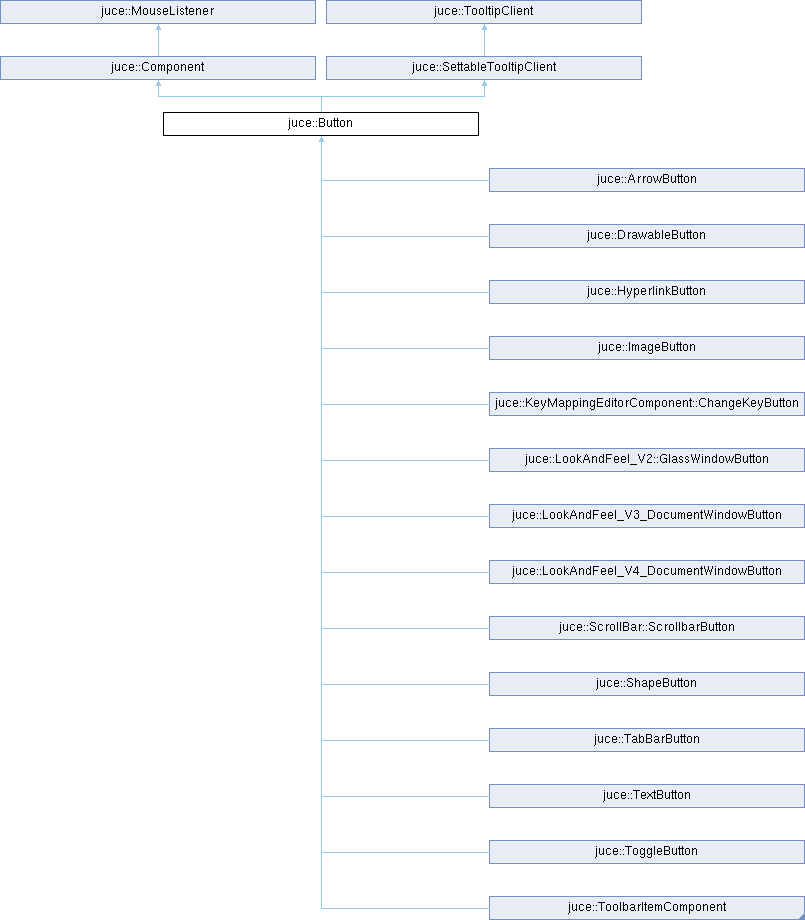
A base class for buttons.
This contains all the logic for button behaviours such as enabling/disabling, responding to shortcut keystrokes, auto-repeating when held down, toggle-buttons and radio groups, etc.
- See also
- TextButton, DrawableButton, ToggleButton
@tags{GUI}
Member Enumeration Documentation
◆ ButtonState
◆ ConnectedEdgeFlags
| enum juce::Button::ConnectedEdgeFlags |
Constructor & Destructor Documentation
◆ Button()
Creates a button.
- Parameters
-
buttonName the text to put in the button (the component's name is also initially set to this string, but these can be changed later using the setName() and setButtonText() methods)
◆ ~Button()
|
override |
Destructor.
Member Function Documentation
◆ addListener()
Registers a listener to receive events when this button's state changes. If the listener is already registered, this will not register it again.
- See also
- removeListener
◆ addShortcut()
Assigns a shortcut key to trigger the button.
The button registers itself with its top-level parent component for keypresses.
Note that a different way of linking buttons to keypresses is by using the setCommandToTrigger() method to invoke a command.
- See also
- clearShortcuts
◆ applicationCommandListChangeCallback()
|
private |
◆ buttonStateChanged()
|
protectedvirtual |
Called when the button's up/down/over state changes.
Subclasses can override this if they need to do something special when the button goes up or down.
- See also
- isDown, isOver
Reimplemented in juce::DrawableButton, and juce::ToolbarButton.
◆ checkToggleableState()
|
private |
◆ clearShortcuts()
| void juce::Button::clearShortcuts | ( | ) |
Removes all key shortcuts that had been set for this button.
- See also
- addShortcut
◆ clicked() [1/2]
|
protectedvirtual |
This method is called when the button has been clicked.
Subclasses can override this to perform whatever actions they need to do. In general, you wouldn't use this method to receive clicks, but should get your callbacks by attaching a std::function to the onClick callback, or adding a Button::Listener.
- See also
- triggerClick, onClick
Reimplemented in juce::HyperlinkButton, juce::KeyMappingEditorComponent::ChangeKeyButton, juce::ScrollBar::ScrollbarButton, and juce::TabBarButton.
◆ clicked() [2/2]
|
protectedvirtual |
This method is called when the button has been clicked.
By default it just calls clicked(), but you might want to override it to handle things like clicking when a modifier key is pressed, etc.
- See also
- ModifierKeys
Reimplemented in juce::HyperlinkButton, juce::KeyMappingEditorComponent::ChangeKeyButton, juce::ScrollBar::ScrollbarButton, and juce::TabBarButton.
◆ createAccessibilityHandler()
|
overrideprivatevirtual |
Override this method to return a custom AccessibilityHandler for this component.
The default implementation creates and returns a AccessibilityHandler object with an unspecified role, meaning that it will be visible to accessibility clients but without a specific role, action callbacks or interfaces. To control how accessibility clients see and interact with your component subclass AccessibilityHandler, implement the desired behaviours, and return an instance of it from this method in your component subclass.
The accessibility handler you return here is guaranteed to be destroyed before its Component, so it's safe to store and use a reference back to the Component inside the AccessibilityHandler if necessary.
- See also
- getAccessibilityHandler
Reimplemented from juce::Component.
Reimplemented in juce::ToggleButton, and juce::ToolbarItemComponent.
◆ enablementChanged()
|
overrideprotectedvirtual |
Callback to indicate that this component has been enabled or disabled.
This can be triggered by one of the component's parent components being enabled or disabled, as well as changes to the component itself.
The default implementation of this method does nothing; your class may wish to repaint itself or something when this happens.
- See also
- setEnabled, isEnabled
Reimplemented from juce::Component.
Reimplemented in juce::DrawableButton, and juce::ToolbarButton.
◆ flashButtonState()
|
private |
◆ focusGained()
|
overrideprotectedvirtual |
Called to indicate that this component has just acquired the keyboard focus.
- See also
- focusLost, setWantsKeyboardFocus, getCurrentlyFocusedComponent, hasKeyboardFocus
Reimplemented from juce::Component.
◆ focusLost()
|
overrideprotectedvirtual |
Called to indicate that this component has just lost the keyboard focus.
- See also
- focusGained, setWantsKeyboardFocus, getCurrentlyFocusedComponent, hasKeyboardFocus
Reimplemented from juce::Component.
◆ getButtonText()
Returns the text displayed in the button.
- See also
- setButtonText
◆ getClickingTogglesState()
|
inlinenoexcept |
Returns true if this button is set to be an automatic toggle-button. This returns the last value that was passed to setClickingTogglesState().
◆ getCommandID()
|
inlinenoexcept |
Returns the command ID that was set by setCommandToTrigger().
◆ getConnectedEdgeFlags()
|
inlinenoexcept |
Returns the set of flags passed into setConnectedEdges().
◆ getMillisecondsSinceButtonDown()
|
noexcept |
Returns the number of milliseconds since the last time the button went into the 'down' state.
◆ getRadioGroupId()
|
inlinenoexcept |
Returns the ID of the group to which this button belongs. (See setRadioGroupId() for an explanation of this).
◆ getState()
|
inlinenoexcept |
Returns the button's current over/down/up state.
◆ getToggleState()
|
inlinenoexcept |
Returns true if the button is 'on'.
By default buttons are 'off' and for simple buttons that you click to perform an action you won't change this. Toggle buttons, however will want to change their state when turned on or off.
- See also
- setToggleState
◆ getToggleStateValue()
|
inlinenoexcept |
◆ getTriggeredOnMouseDown()
|
noexcept |
Returns whether the button click happens when the mouse is pressed or released.
- See also
- setTriggeredOnMouseDown
◆ handleCommandMessage()
Called to handle a command that was sent by postCommandMessage().
This is called by the message thread when a command message arrives, and the component can override this method to process it in any way it needs to.
- See also
- postCommandMessage
Reimplemented from juce::Component.
◆ internalClickCallback()
|
protectedvirtual |
◆ isConnectedOnBottom()
|
inlinenoexcept |
Indicates whether the button adjoins another one on its bottom edge.
- See also
- setConnectedEdges
◆ isConnectedOnLeft()
|
inlinenoexcept |
Indicates whether the button adjoins another one on its left edge.
- See also
- setConnectedEdges
◆ isConnectedOnRight()
|
inlinenoexcept |
Indicates whether the button adjoins another one on its right edge.
- See also
- setConnectedEdges
◆ isConnectedOnTop()
|
inlinenoexcept |
Indicates whether the button adjoins another one on its top edge.
- See also
- setConnectedEdges
◆ isDown()
|
noexcept |
Returns true if the button is currently being held down.
- See also
- isOver
◆ isMouseSourceOver()
|
private |
◆ isOver()
|
noexcept |
Returns true if the mouse is currently over the button. This will be also be true if the button is being held down.
- See also
- isDown
◆ isRegisteredForShortcut()
Returns true if the given keypress is a shortcut for this button.
- See also
- addShortcut
◆ isShortcutPressed()
|
private |
◆ isToggleable()
|
inlinenoexcept |
Returns true if the button's on/off state is toggleable.
- See also
- setToggleable, setClickingTogglesState
◆ keyPressed()
Called when a key is pressed.
When a key is pressed, the component that has the keyboard focus will have this method called. Remember that a component will only be given the focus if its setWantsKeyboardFocus() method has been used to enable this.
If your implementation returns true, the event will be consumed and not passed on to any other listeners. If it returns false, the key will be passed to any KeyListeners that have been registered with this component. As soon as one of these returns true, the process will stop, but if they all return false, the event will be passed upwards to this component's parent, and so on.
The default implementation of this method does nothing and returns false.
- See also
- keyStateChanged, getCurrentlyFocusedComponent, addKeyListener
Reimplemented from juce::Component.
◆ keyStateChanged()
|
protectedvirtual |
Called when a key is pressed or released.
Whenever a key on the keyboard is pressed or released (including modifier keys like shift and ctrl), this method will be called on the component that currently has the keyboard focus. Remember that a component will only be given the focus if its setWantsKeyboardFocus() method has been used to enable this.
If your implementation returns true, the event will be consumed and not passed on to any other listeners. If it returns false, then any KeyListeners that have been registered with this component will have their keyStateChanged methods called. As soon as one of these returns true, the process will stop, but if they all return false, the event will be passed upwards to this component's parent, and so on.
The default implementation of this method does nothing and returns false.
To find out which keys are up or down at any time, see the KeyPress::isKeyCurrentlyDown() method.
- Parameters
-
isKeyDown true if a key has been pressed; false if it has been released
- See also
- keyPressed, KeyPress, getCurrentlyFocusedComponent, addKeyListener
Reimplemented from juce::Component.
◆ keyStateChangedCallback()
|
private |
◆ mouseDown()
|
overrideprotectedvirtual |
Called when a mouse button is pressed.
The MouseEvent object passed in contains lots of methods for finding out which button was pressed, as well as which modifier keys (e.g. shift, ctrl) were held down at the time.
Once a button is held down, the mouseDrag method will be called when the mouse moves, until the button is released.
- Parameters
-
Event details about the position and status of the mouse event, including the source component in which it occurred
- See also
- mouseUp, mouseDrag, mouseDoubleClick, contains
Reimplemented from juce::MouseListener.
◆ mouseDrag()
|
overrideprotectedvirtual |
Called when the mouse is moved while a button is held down.
When a mouse button is pressed inside a component, that component receives mouseDrag callbacks each time the mouse moves, even if the mouse strays outside the component's bounds.
- Parameters
-
Event details about the position and status of the mouse event, including the source component in which it occurred
- See also
- mouseDown, mouseUp, mouseMove, contains, setDragRepeatInterval
Reimplemented from juce::MouseListener.
◆ mouseEnter()
|
overrideprotectedvirtual |
Called when the mouse first enters a component.
If the mouse button isn't pressed and the mouse moves into a component, this will be called to let the component react to this.
When the mouse button is pressed and held down while being moved in or out of a component, no mouseEnter or mouseExit callbacks are made - only mouseDrag messages are sent to the component that the mouse was originally clicked on, until the button is released.
- Parameters
-
Event details about the position and status of the mouse event, including the source component in which it occurred
- See also
- mouseExit, mouseDrag, mouseMove, contains
Reimplemented from juce::MouseListener.
◆ mouseExit()
|
overrideprotectedvirtual |
Called when the mouse moves out of a component.
This will be called when the mouse moves off the edge of this component.
If the mouse button was pressed, and it was then dragged off the edge of the component and released, then this callback will happen when the button is released, after the mouseUp callback.
- Parameters
-
Event details about the position and status of the mouse event, including the source component in which it occurred
- See also
- mouseEnter, mouseDrag, mouseMove, contains
Reimplemented from juce::MouseListener.
◆ mouseUp()
|
overrideprotectedvirtual |
Called when a mouse button is released.
A mouseUp callback is sent to the component in which a button was pressed even if the mouse is actually over a different component when the button is released.
The MouseEvent object passed in contains lots of methods for finding out which buttons were down just before they were released.
- Parameters
-
Event details about the position and status of the mouse event, including the source component in which it occurred
- See also
- mouseDown, mouseDrag, mouseDoubleClick, contains
Reimplemented from juce::MouseListener.
◆ paint()
Components can override this method to draw their content.
The paint() method gets called when a region of a component needs redrawing, either because the component's repaint() method has been called, or because something has happened on the screen that means a section of a window needs to be redrawn.
Any child components will draw themselves over whatever this method draws. If you need to paint over the top of your child components, you can also implement the paintOverChildren() method to do this.
If you want to cause a component to redraw itself, this is done asynchronously - calling the repaint() method marks a region of the component as "dirty", and the paint() method will automatically be called sometime later, by the message thread, to paint any bits that need refreshing. In JUCE (and almost all modern UI frameworks), you never redraw something synchronously.
You should never need to call this method directly - to take a snapshot of the component you could use createComponentSnapshot() or paintEntireComponent().
- Parameters
-
g the graphics context that must be used to do the drawing operations.
- See also
- repaint, paintOverChildren, Graphics
Reimplemented from juce::Component.
Reimplemented in juce::Toolbar::Spacer.
◆ paintButton()
|
protectedpure virtual |
Subclasses should override this to actually paint the button's contents.
It's better to use this than the paint method, because it gives you information about the over/down state of the button.
- Parameters
-
g the graphics context to use shouldDrawButtonAsHighlighted true if the button is either in the 'over' or 'down' state shouldDrawButtonAsDown true if the button should be drawn in the 'down' position
Implemented in juce::ArrowButton, juce::DrawableButton, juce::HyperlinkButton, juce::ImageButton, juce::KeyMappingEditorComponent::ChangeKeyButton, juce::LookAndFeel_V2::GlassWindowButton, juce::LookAndFeel_V3_DocumentWindowButton, juce::LookAndFeel_V4_DocumentWindowButton, juce::ScrollBar::ScrollbarButton, juce::ShapeButton, juce::TabBarButton, juce::TextButton, juce::ToggleButton, and juce::ToolbarItemComponent.
◆ parentHierarchyChanged()
|
overrideprotectedvirtual |
Called to indicate that the component's parents have changed.
When a component is added or removed from its parent, this method will be called on all of its children (recursively - so all children of its children will also be called as well).
Subclasses can override this if they need to react to this in some way.
- See also
- getParentComponent, isShowing, ComponentListener::componentParentHierarchyChanged
Reimplemented from juce::Component.
◆ removeListener()
Removes a previously-registered button listener
- See also
- addListener
◆ repeatTimerCallback()
|
private |
◆ sendClickMessage()
|
private |
◆ sendStateMessage()
|
private |
◆ setButtonText()
Changes the button's text.
- See also
- getButtonText
◆ setClickingTogglesState()
|
noexcept |
This tells the button to automatically flip the toggle state when the button is clicked.
If set to true, then before the clicked() callback occurs, the toggle-state of the button is flipped. This will also cause isToggleable() to return true.
- See also
- isToggleable
◆ setCommandToTrigger()
| void juce::Button::setCommandToTrigger | ( | ApplicationCommandManager * | commandManagerToUse, |
| CommandID | commandID, | ||
| bool | generateTooltip ) |
Sets a command ID for this button to automatically invoke when it's clicked.
When the button is pressed, it will use the given manager to trigger the command ID.
Obviously be careful that the ApplicationCommandManager doesn't get deleted before this button is. To disable the command triggering, call this method and pass nullptr as the command manager.
If generateTooltip is true, then the button's tooltip will be automatically generated based on the name of this command and its current shortcut key.
- See also
- addShortcut, getCommandID
◆ setConnectedEdges()
Hints about which edges of the button might be connected to adjoining buttons.
The value passed in is a bitwise combination of any of the values in the ConnectedEdgeFlags enum.
E.g. if you are placing two buttons adjacent to each other, you could use this to indicate which edges are touching, and the LookAndFeel might choose to drawn them without rounded corners on the edges that connect. It's only a hint, so the LookAndFeel can choose to ignore it if it's not relevant for this type of button.
◆ setRadioGroupId()
| void juce::Button::setRadioGroupId | ( | int | newGroupId, |
| NotificationType | notification = sendNotification ) |
Enables the button to act as a member of a mutually-exclusive group of 'radio buttons'.
If the group ID is set to a non-zero number, then this button will act as part of a group of buttons with the same ID, only one of which can be 'on' at the same time. Note that when it's part of a group, clicking a toggle-button that's 'on' won't turn it off.
To find other buttons with the same ID, this button will search through its sibling components for ToggleButtons, so all the buttons for a particular group must be placed inside the same parent component.
Set the group ID back to zero if you want it to act as a normal toggle button again.
The notification argument lets you specify how other buttons should react to being turned on or off in response to this call.
- See also
- getRadioGroupId
◆ setRepeatSpeed()
|
noexcept |
Sets an auto-repeat speed for the button when it is held down.
(Auto-repeat is disabled by default).
- Parameters
-
initialDelayInMillisecs how long to wait after the mouse is pressed before triggering the next click. If this is zero, auto-repeat is disabled repeatDelayInMillisecs the frequently subsequent repeated clicks should be triggered minimumDelayInMillisecs if this is greater than 0, the auto-repeat speed will get faster, the longer the button is held down, up to the minimum interval specified here
◆ setState()
| void juce::Button::setState | ( | ButtonState | newState | ) |
Can be used to force the button into a particular state.
This only changes the button's appearance, it won't trigger a click, or stop any mouse-clicks from happening.
The state that you set here will only last until it is automatically changed when the mouse enters or exits the button, or the mouse-button is pressed or released.
◆ setToggleable()
| void juce::Button::setToggleable | ( | bool | shouldBeToggleable | ) |
Indicates that the button's on/off state is toggleable.
By default this is false, and will only be true for ToggleButtons, buttons that are a part of a radio button group, and buttons for which getClickingTogglesState() == true, however you can use this method to manually indicate that a button is toggleable.
This will present the button as toggleable to accessibility clients and add an accessible "toggle" action for the button that invokes setToggleState().
- See also
- ToggleButton, isToggleable, setToggleState, setClickingTogglesState, setRadioGroupId
◆ setToggleState() [1/3]
|
private |
◆ setToggleState() [2/3]
| void juce::Button::setToggleState | ( | bool | shouldBeOn, |
| NotificationType | notification ) |
A button has an on/off state associated with it, and this changes that.
By default buttons are 'off' and for simple buttons that you click to perform an action you won't change this. Toggle buttons, however will want to change their state when turned on or off.
- Parameters
-
shouldBeOn whether to set the button's toggle state to be on or off. If it's a member of a button group, this will always try to turn it on, and to turn off any other buttons in the group notification determines the behaviour if the value changes - this can invoke a synchronous call to clicked(), but sendNotificationAsync is not supported
- See also
- getToggleState, setRadioGroupId
◆ setToggleState() [3/3]
| void juce::Button::setToggleState | ( | bool | shouldBeOn, |
| bool | sendChange ) |
◆ setTooltip()
Sets the tooltip for this button.
- See also
- TooltipClient, TooltipWindow
Reimplemented from juce::SettableTooltipClient.
◆ setTriggeredOnMouseDown()
|
noexcept |
Sets whether the button click should happen when the mouse is pressed or released.
By default the button is only considered to have been clicked when the mouse is released, but setting this to true will make it call the clicked() method as soon as the button is pressed.
This is useful if the button is being used to show a pop-up menu, as it allows the click to be used as a drag onto the menu.
◆ triggerClick()
|
virtual |
Causes the button to act as if it's been clicked.
This will asynchronously make the button draw itself going down and up, and will then call back the clicked() method as if mouse was clicked on it.
- See also
- clicked
◆ turnOffOtherButtonsInGroup()
|
private |
◆ updateAutomaticTooltip()
|
private |
◆ updateState() [1/2]
|
private |
◆ updateState() [2/2]
|
private |
◆ visibilityChanged()
|
overrideprotectedvirtual |
Called when this component's visibility changes.
- See also
- setVisible, isVisible
Reimplemented from juce::Component.
Member Data Documentation
◆ autoRepeatDelay
|
private |
◆ autoRepeatMinimumDelay
|
private |
◆ autoRepeatSpeed
|
private |
◆ buttonListeners
|
private |
◆ buttonPressTime
|
private |
◆ buttonState
|
private |
◆ callbackHelper
|
private |
◆ canBeToggled
|
private |
◆ clickTogglesState
|
private |
◆ commandID
|
private |
◆ commandManagerToUse
|
private |
◆ connectedEdgeFlags
|
private |
◆ generateTooltip
|
private |
◆ isKeyDown
|
private |
◆ isOn
|
private |
◆ keySource
|
private |
◆ lastRepeatTime
|
private |
◆ lastStatePainted
|
private |
◆ lastToggleState
|
private |
◆ needsRepainting
|
private |
◆ needsToRelease
|
private |
◆ onClick
| std::function<void()> juce::Button::onClick |
You can assign a lambda to this callback object to have it called when the button is clicked.
◆ onStateChange
| std::function<void()> juce::Button::onStateChange |
You can assign a lambda to this callback object to have it called when the button's state changes.
◆ radioGroupId
|
private |
◆ shortcuts
◆ text
|
private |
◆ triggerOnMouseDown
|
private |
The documentation for this class was generated from the following files:
- /home/runner/work/lmms-fork/lmms-fork/plugins/CarlaBase/carla/source/modules/juce_gui_basics/buttons/juce_Button.h
- /home/runner/work/lmms-fork/lmms-fork/plugins/CarlaBase/carla/source/modules/juce_gui_basics/buttons/juce_Button.cpp
Generated on for LMMS by
 1.16.1