#include <juce_BufferingAudioSource.h>
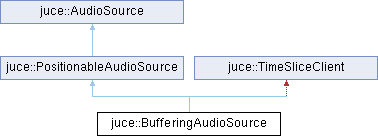
Public Member Functions | |
| BufferingAudioSource (PositionableAudioSource *source, TimeSliceThread &backgroundThread, bool deleteSourceWhenDeleted, int numberOfSamplesToBuffer, int numberOfChannels=2, bool prefillBufferOnPrepareToPlay=true) | |
| ~BufferingAudioSource () override | |
| void | prepareToPlay (int samplesPerBlockExpected, double sampleRate) override |
| void | releaseResources () override |
| void | getNextAudioBlock (const AudioSourceChannelInfo &) override |
| void | setNextReadPosition (int64 newPosition) override |
| int64 | getNextReadPosition () const override |
| int64 | getTotalLength () const override |
| bool | isLooping () const override |
| bool | waitForNextAudioBlockReady (const AudioSourceChannelInfo &info, const uint32 timeout) |
| Public Member Functions inherited from juce::PositionableAudioSource | |
| ~PositionableAudioSource () override=default | |
| virtual void | setLooping (bool shouldLoop) |
| Public Member Functions inherited from juce::AudioSource | |
| virtual | ~AudioSource ()=default |
Private Member Functions | |
| Range< int > | getValidBufferRange (int numSamples) const |
| bool | readNextBufferChunk () |
| void | readBufferSection (int64 start, int length, int bufferOffset) |
| int | useTimeSlice () override |
| Private Member Functions inherited from juce::TimeSliceClient | |
| virtual | ~TimeSliceClient ()=default |
Private Attributes | |
| OptionalScopedPointer< PositionableAudioSource > | source |
| TimeSliceThread & | backgroundThread |
| int | numberOfSamplesToBuffer |
| int | numberOfChannels |
| AudioBuffer< float > | buffer |
| CriticalSection | callbackLock |
| CriticalSection | bufferRangeLock |
| WaitableEvent | bufferReadyEvent |
| int64 | bufferValidStart = 0 |
| int64 | bufferValidEnd = 0 |
| std::atomic< int64 > | nextPlayPos { 0 } |
| double | sampleRate = 0 |
| bool | wasSourceLooping = false |
| bool | isPrepared = false |
| const bool | prefillBuffer |
Additional Inherited Members | |
| Protected Member Functions inherited from juce::PositionableAudioSource | |
| PositionableAudioSource ()=default | |
| Protected Member Functions inherited from juce::AudioSource | |
| AudioSource ()=default | |
Detailed Description
An AudioSource which takes another source as input, and buffers it using a thread.
Create this as a wrapper around another thread, and it will read-ahead with a background thread to smooth out playback. You can either create one of these directly, or use it indirectly using an AudioTransportSource.
@tags{Audio}
Constructor & Destructor Documentation
◆ BufferingAudioSource()
| juce::BufferingAudioSource::BufferingAudioSource | ( | PositionableAudioSource * | source, |
| TimeSliceThread & | backgroundThread, | ||
| bool | deleteSourceWhenDeleted, | ||
| int | numberOfSamplesToBuffer, | ||
| int | numberOfChannels = 2, | ||
| bool | prefillBufferOnPrepareToPlay = true ) |
Creates a BufferingAudioSource.
- Parameters
-
source the input source to read from backgroundThread a background thread that will be used for the background read-ahead. This object must not be deleted until after any BufferingAudioSources that are using it have been deleted! deleteSourceWhenDeleted if true, then the input source object will be deleted when this object is deleted numberOfSamplesToBuffer the size of buffer to use for reading ahead numberOfChannels the number of channels that will be played prefillBufferOnPrepareToPlay if true, then calling prepareToPlay on this object will block until the buffer has been filled
◆ ~BufferingAudioSource()
|
override |
Destructor.
The input source may be deleted depending on whether the deleteSourceWhenDeleted flag was set in the constructor.
Member Function Documentation
◆ getNextAudioBlock()
|
overridevirtual |
Implementation of the AudioSource method.
Implements juce::AudioSource.
◆ getNextReadPosition()
|
overridevirtual |
Implements the PositionableAudioSource method.
Implements juce::PositionableAudioSource.
◆ getTotalLength()
|
inlineoverridevirtual |
Implements the PositionableAudioSource method.
Implements juce::PositionableAudioSource.
◆ getValidBufferRange()
◆ isLooping()
|
inlineoverridevirtual |
Implements the PositionableAudioSource method.
Implements juce::PositionableAudioSource.
◆ prepareToPlay()
|
overridevirtual |
Implementation of the AudioSource method.
Implements juce::AudioSource.
◆ readBufferSection()
|
private |
◆ readNextBufferChunk()
|
private |
◆ releaseResources()
|
overridevirtual |
Implementation of the AudioSource method.
Implements juce::AudioSource.
◆ setNextReadPosition()
Implements the PositionableAudioSource method.
Implements juce::PositionableAudioSource.
◆ useTimeSlice()
|
overrideprivatevirtual |
Called back by a TimeSliceThread.
When you register this class with it, a TimeSliceThread will repeatedly call this method.
The implementation of this method should use its time-slice to do something that's quick - never block for longer than absolutely necessary.
- Returns
- Your method should return the number of milliseconds which it would like to wait before being called again. Returning 0 will make the thread call again as soon as possible (after possibly servicing other busy clients). If you return a value below zero, your client will be removed from the list of clients, and won't be called again. The value you specify isn't a guarantee, and is only used as a hint by the thread - the actual time before the next callback may be more or less than specified. You can force the TimeSliceThread to wake up and poll again immediately by calling its notify() method.
Implements juce::TimeSliceClient.
◆ waitForNextAudioBlockReady()
| bool juce::BufferingAudioSource::waitForNextAudioBlockReady | ( | const AudioSourceChannelInfo & | info, |
| const uint32 | timeout ) |
A useful function to block until the next the buffer info can be filled.
This is useful for offline rendering.
Member Data Documentation
◆ backgroundThread
|
private |
◆ buffer
|
private |
◆ bufferRangeLock
|
private |
◆ bufferReadyEvent
|
private |
◆ bufferValidEnd
|
private |
◆ bufferValidStart
|
private |
◆ callbackLock
|
private |
◆ isPrepared
|
private |
◆ nextPlayPos
|
private |
◆ numberOfChannels
|
private |
◆ numberOfSamplesToBuffer
|
private |
◆ prefillBuffer
|
private |
◆ sampleRate
|
private |
◆ source
|
private |
◆ wasSourceLooping
|
private |
The documentation for this class was generated from the following files:
- /home/runner/work/lmms-fork/lmms-fork/plugins/CarlaBase/carla/source/modules/juce_audio_basics/sources/juce_BufferingAudioSource.h
- /home/runner/work/lmms-fork/lmms-fork/plugins/CarlaBase/carla/source/modules/juce_audio_basics/sources/juce_BufferingAudioSource.cpp
Generated on for LMMS by
 1.16.1