#include <juce_CustomTypeface.h>
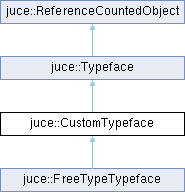
Classes | |
| class | GlyphInfo |
Protected Member Functions | |
| virtual bool | loadGlyphIfPossible (juce_wchar characterNeeded) |
| Protected Member Functions inherited from juce::Typeface | |
| Typeface (const String &name, const String &style) noexcept | |
| Protected Member Functions inherited from juce::ReferenceCountedObject | |
| ReferenceCountedObject ()=default | |
| ReferenceCountedObject (const ReferenceCountedObject &) noexcept | |
| ReferenceCountedObject (ReferenceCountedObject &&) noexcept | |
| ReferenceCountedObject & | operator= (const ReferenceCountedObject &) noexcept |
| ReferenceCountedObject & | operator= (ReferenceCountedObject &&) noexcept |
| virtual | ~ReferenceCountedObject () |
| void | resetReferenceCount () noexcept |
Protected Attributes | |
| juce_wchar | defaultCharacter |
| float | ascent |
| Protected Attributes inherited from juce::Typeface | |
| String | name |
| String | style |
Private Member Functions | |
| GlyphInfo * | findGlyph (const juce_wchar character, bool loadIfNeeded) noexcept |
Private Attributes | |
| OwnedArray< GlyphInfo > | glyphs |
| short | lookupTable [128] |
Additional Inherited Members | |
| Public Types inherited from juce::Typeface | |
| using | Ptr = ReferenceCountedObjectPtr<Typeface> |
| Static Public Member Functions inherited from juce::Typeface | |
| static Ptr | createSystemTypefaceFor (const Font &font) |
| static Ptr | createSystemTypefaceFor (const void *fontFileData, size_t fontFileDataSize) |
| static void | setTypefaceCacheSize (int numFontsToCache) |
| static void | clearTypefaceCache () |
| static void | scanFolderForFonts (const File &folder) |
| Static Protected Member Functions inherited from juce::Typeface | |
| static Ptr | getFallbackTypeface () |
Detailed Description
A typeface that can be populated with custom glyphs.
You can create a CustomTypeface if you need one that contains your own glyphs, or if you need to load a typeface from a Juce-formatted binary stream.
If you want to create a copy of a native face, you can use addGlyphsFromOtherTypeface() to copy glyphs into this face.
NOTE! For most people this class is almost certainly NOT the right tool to use! If what you want to do is to embed a font into your exe, then your best plan is probably to embed your TTF/OTF font file into your binary using the Projucer, and then call Typeface::createSystemTypefaceFor() to load it from memory.
@tags{Graphics}
Constructor & Destructor Documentation
◆ CustomTypeface() [1/2]
| juce::CustomTypeface::CustomTypeface | ( | ) |
Creates a new, empty typeface.
◆ CustomTypeface() [2/2]
|
explicit |
Loads a typeface from a previously saved stream. The stream must have been created by writeToStream().
NOTE! Since this class was written, support was added for loading real font files from memory, so for most people, using Typeface::createSystemTypefaceFor() to load a real font is more appropriate than using this class to store it in a proprietary format.
- See also
- writeToStream
◆ ~CustomTypeface()
|
override |
Destructor.
Member Function Documentation
◆ addGlyph()
|
noexcept |
Adds a glyph to the typeface.
The path that is passed in is normalised so that the font height is 1.0, and its origin is the anchor point of the character on its baseline.
The width is the nominal width of the character, and any extra kerning values that are specified will be added to this width.
◆ addGlyphsFromOtherTypeface()
|
noexcept |
Adds a range of glyphs from another typeface. This will attempt to pull in the paths and kerning information from another typeface and add it to this one.
◆ addKerningPair()
|
noexcept |
Specifies an extra kerning amount to be used between a pair of characters. The amount will be added to the nominal width of the first character when laying out a string.
◆ clear()
| void juce::CustomTypeface::clear | ( | ) |
Resets this typeface, deleting all its glyphs and settings.
◆ findGlyph()
|
privatenoexcept |
◆ getAscent()
|
overridevirtual |
Returns the ascent of the font, as a proportion of its height. The height is considered to always be normalised as 1.0, so this will be a value less that 1.0, indicating the proportion of the font that lies above its baseline.
Implements juce::Typeface.
◆ getDescent()
|
overridevirtual |
Returns the descent of the font, as a proportion of its height. The height is considered to always be normalised as 1.0, so this will be a value less that 1.0, indicating the proportion of the font that lies below its baseline.
Implements juce::Typeface.
◆ getEdgeTableForGlyph()
|
overridevirtual |
Returns a new EdgeTable that contains the path for the given glyph, with the specified transform applied.
Reimplemented from juce::Typeface.
◆ getGlyphPositions()
|
overridevirtual |
Converts a line of text into its glyph numbers and their positions. The distances returned are based on the font having an normalised height of 1.0. You should never need to call this directly! Use Font::getGlyphPositions() instead!
Implements juce::Typeface.
◆ getHeightToPointsFactor()
|
overridevirtual |
Returns the value by which you should multiply a JUCE font-height value to convert it to the equivalent point-size.
Implements juce::Typeface.
◆ getOutlineForGlyph()
Returns the outline for a glyph. The path returned will be normalised to a font height of 1.0.
Implements juce::Typeface.
◆ getStringWidth()
Measures the width of a line of text. The distance returned is based on the font having an normalised height of 1.0. You should never need to call this directly! Use Font::getStringWidth() instead!
Implements juce::Typeface.
◆ loadGlyphIfPossible()
|
protectedvirtual |
If a subclass overrides this, it can load glyphs into the font on-demand. When methods such as getGlyphPositions() or getOutlineForGlyph() are asked for a particular character and there's no corresponding glyph, they'll call this method so that a subclass can try to add that glyph, returning true if it manages to do so.
Reimplemented in juce::FreeTypeTypeface.
◆ setCharacteristics() [1/2]
|
noexcept |
Sets the vital statistics for the typeface.
- Parameters
-
fontFamily the typeface's font family fontStyle the typeface's font style ascent the ascent - this is normalised to a height of 1.0 and this is the value that will be returned by Typeface::getAscent(). The descent is assumed to be (1.0 - ascent) defaultCharacter the character to be used as a replacement if there's no glyph available for the character that's being drawn
◆ setCharacteristics() [2/2]
|
noexcept |
Sets the vital statistics for the typeface.
- Parameters
-
fontFamily the typeface's font family ascent the ascent - this is normalised to a height of 1.0 and this is the value that will be returned by Typeface::getAscent(). The descent is assumed to be (1.0 - ascent) isBold should be true if the typeface is bold isItalic should be true if the typeface is italic defaultCharacter the character to be used as a replacement if there's no glyph available for the character that's being drawn
◆ writeToStream()
| bool juce::CustomTypeface::writeToStream | ( | OutputStream & | outputStream | ) |
Saves this typeface as a Juce-formatted font file. A CustomTypeface can be created to reload the data that is written - see the CustomTypeface constructor.
NOTE! Since this class was written, support was added for loading real font files from memory, so for most people, using Typeface::createSystemTypefaceFor() to load a real font is more appropriate than using this class to store it in a proprietary format.
Member Data Documentation
◆ ascent
|
protected |
◆ defaultCharacter
|
protected |
◆ glyphs
|
private |
◆ lookupTable
|
private |
The documentation for this class was generated from the following files:
- /home/runner/work/lmms-fork/lmms-fork/plugins/CarlaBase/carla/source/modules/juce_graphics/fonts/juce_CustomTypeface.h
- /home/runner/work/lmms-fork/lmms-fork/plugins/CarlaBase/carla/source/modules/juce_graphics/fonts/juce_CustomTypeface.cpp
Generated on for LMMS by
 1.16.1