#include <juce_ComponentAnimator.h>
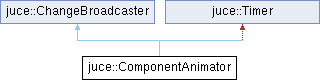
Classes | |
| class | AnimationTask |
Private Member Functions | |
| AnimationTask * | findTaskFor (Component *) const noexcept |
| void | timerCallback () override |
| Private Member Functions inherited from juce::Timer | |
| virtual | ~Timer () |
| void | startTimer (int intervalInMilliseconds) noexcept |
| void | startTimerHz (int timerFrequencyHz) noexcept |
| void | stopTimer () noexcept |
| bool | isTimerRunning () const noexcept |
| int | getTimerInterval () const noexcept |
| Timer () noexcept | |
| Timer (const Timer &) noexcept | |
Private Attributes | |
| OwnedArray< AnimationTask > | tasks |
| uint32 | lastTime |
Additional Inherited Members | |
| Static Private Member Functions inherited from juce::Timer | |
| static void JUCE_CALLTYPE | callAfterDelay (int milliseconds, std::function< void()> functionToCall) |
| static void JUCE_CALLTYPE | callPendingTimersSynchronously () |
Detailed Description
Animates a set of components, moving them to a new position and/or fading their alpha levels.
To animate a component, create a ComponentAnimator instance or (preferably) use the global animator object provided by Desktop::getAnimator(), and call its animateComponent() method to commence the movement.
If you're using your own ComponentAnimator instance, you'll need to make sure it isn't deleted before it finishes moving the components, or they'll be abandoned before reaching their destinations.
It's ok to delete components while they're being animated - the animator will detect this and safely stop using them.
The class is a ChangeBroadcaster and sends a notification when any components start or finish being animated.
- See also
- Desktop::getAnimator
@tags{GUI}
Constructor & Destructor Documentation
◆ ComponentAnimator()
| juce::ComponentAnimator::ComponentAnimator | ( | ) |
Creates a ComponentAnimator.
◆ ~ComponentAnimator()
|
override |
Destructor.
Member Function Documentation
◆ animateComponent()
| void juce::ComponentAnimator::animateComponent | ( | Component * | component, |
| const Rectangle< int > & | finalBounds, | ||
| float | finalAlpha, | ||
| int | animationDurationMilliseconds, | ||
| bool | useProxyComponent, | ||
| double | startSpeed, | ||
| double | endSpeed ) |
Starts a component moving from its current position to a specified position.
If the component is already in the middle of an animation, that will be abandoned, and a new animation will begin, moving the component from its current location.
The start and end speed parameters let you apply some acceleration to the component's movement.
- Parameters
-
component the component to move finalBounds the destination bounds to which the component should move. To leave the component in the same place, just pass component->getBounds() for this value finalAlpha the alpha value that the component should have at the end of the animation animationDurationMilliseconds how long the animation should last, in milliseconds useProxyComponent if true, this means the component should be replaced by an internally managed temporary component which is a snapshot of the original component. This avoids the component having to paint itself as it moves, so may be more efficient. This option also allows you to delete the original component immediately after starting the animation, because the animation can proceed without it. If you use a proxy, the original component will be made invisible by this call, and then will become visible again at the end of the animation. It'll also mean that the proxy component will be temporarily added to the component's parent, so avoid it if this might confuse the parent component, or if there's a chance the parent might decide to delete its children. startSpeed a value to indicate the relative start speed of the animation. If this is 0, the component will start by accelerating from rest; higher values mean that it will have an initial speed greater than zero. If the value is greater than 1, it will decelerate towards the middle of its journey. To move the component at a constant rate for its entire animation, set both the start and end speeds to 1.0 endSpeed a relative speed at which the component should be moving when the animation finishes. If this is 0, the component will decelerate to a standstill at its final position; higher values mean the component will still be moving when it stops. To move the component at a constant rate for its entire animation, set both the start and end speeds to 1.0
◆ cancelAllAnimations()
| void juce::ComponentAnimator::cancelAllAnimations | ( | bool | moveComponentsToTheirFinalPositions | ) |
Clears all of the active animations.
If moveComponentsToTheirFinalPositions is true, all the components will be immediately set to their final positions. If false, they will be left in whatever locations they currently occupy.
◆ cancelAnimation()
| void juce::ComponentAnimator::cancelAnimation | ( | Component * | component, |
| bool | moveComponentToItsFinalPosition ) |
Stops a component if it's currently being animated.
If moveComponentToItsFinalPosition is true, then the component will be immediately moved to its destination position and size. If false, it will be left in whatever location it currently occupies.
◆ fadeIn()
Begins a fade-in of a component. This is a quick way of invoking animateComponent() with a target alpha value of 1.0f.
◆ fadeOut()
Begins a fade-out of this components alpha level. This is a quick way of invoking animateComponent() with a target alpha value of 0.0f, using a proxy. You're safe to delete the component after calling this method, and this won't interfere with the animation's progress.
◆ findTaskFor()
|
privatenoexcept |
◆ getComponentDestination()
Returns the destination position for a component.
If the component is being animated, this will return the target position that was specified when animateComponent() was called.
If the specified component isn't currently being animated, this method will just return its current position.
◆ isAnimating() [1/2]
|
noexcept |
Returns true if any components are currently being animated.
◆ isAnimating() [2/2]
|
noexcept |
Returns true if the specified component is currently being animated.
◆ timerCallback()
|
overrideprivatevirtual |
The user-defined callback routine that actually gets called periodically.
It's perfectly ok to call startTimer() or stopTimer() from within this callback to change the subsequent intervals.
Implements juce::Timer.
Member Data Documentation
◆ lastTime
|
private |
◆ tasks
|
private |
The documentation for this class was generated from the following files:
- /home/runner/work/lmms-fork/lmms-fork/plugins/CarlaBase/carla/source/modules/juce_gui_basics/layout/juce_ComponentAnimator.h
- /home/runner/work/lmms-fork/lmms-fork/plugins/CarlaBase/carla/source/modules/juce_gui_basics/layout/juce_ComponentAnimator.cpp
Generated on for LMMS by
 1.16.1