#include <juce_BufferingAudioFormatReader.h>
|
| | BufferingAudioReader (AudioFormatReader *sourceReader, TimeSliceThread &timeSliceThread, int samplesToBuffer) |
| | ~BufferingAudioReader () override |
| void | setReadTimeout (int timeoutMilliseconds) noexcept |
| bool | readSamples (int **destSamples, int numDestChannels, int startOffsetInDestBuffer, int64 startSampleInFile, int numSamples) override |
| virtual | ~AudioFormatReader () |
| const String & | getFormatName () const noexcept |
| bool | read (float *const *destChannels, int numDestChannels, int64 startSampleInSource, int numSamplesToRead) |
| bool | read (int *const *destChannels, int numDestChannels, int64 startSampleInSource, int numSamplesToRead, bool fillLeftoverChannelsWithCopies) |
| bool | read (AudioBuffer< float > *buffer, int startSampleInDestBuffer, int numSamples, int64 readerStartSample, bool useReaderLeftChan, bool useReaderRightChan) |
| virtual void | readMaxLevels (int64 startSample, int64 numSamples, Range< float > *results, int numChannelsToRead) |
| virtual void | readMaxLevels (int64 startSample, int64 numSamples, float &lowestLeft, float &highestLeft, float &lowestRight, float &highestRight) |
| int64 | searchForLevel (int64 startSample, int64 numSamplesToSearch, double magnitudeRangeMinimum, double magnitudeRangeMaximum, int minimumConsecutiveSamples) |
| virtual AudioChannelSet | getChannelLayout () |
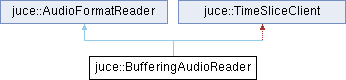
An AudioFormatReader that uses a background thread to pre-read data from another reader.
- See also
- AudioFormatReader
@tags{Audio}
◆ BufferingAudioReader()
Creates a reader.
- Parameters
-
| sourceReader | the source reader to wrap. This BufferingAudioReader takes ownership of this object and will delete it later when no longer needed |
| timeSliceThread | the thread that should be used to do the background reading. Make sure that the thread you supply is running, and won't be deleted while the reader object still exists. |
| samplesToBuffer | the total number of samples to buffer ahead. |
◆ ~BufferingAudioReader()
| juce::BufferingAudioReader::~BufferingAudioReader |
( |
| ) |
|
|
override |
◆ getBlockContaining()
◆ readNextBufferChunk()
| bool juce::BufferingAudioReader::readNextBufferChunk |
( |
| ) |
|
|
private |
◆ readSamples()
| bool juce::BufferingAudioReader::readSamples |
( |
int ** | destChannels, |
|
|
int | numDestChannels, |
|
|
int | startOffsetInDestBuffer, |
|
|
int64 | startSampleInFile, |
|
|
int | numSamples ) |
|
overridevirtual |
Subclasses must implement this method to perform the low-level read operation.
Callers should use read() instead of calling this directly.
- Parameters
-
| destChannels | the array of destination buffers to fill. Some of these pointers may be null |
| numDestChannels | the number of items in the destChannels array. This value is guaranteed not to be greater than the number of channels that this reader object contains |
| startOffsetInDestBuffer | the number of samples from the start of the dest data at which to begin writing |
| startSampleInFile | the number of samples into the source data at which to begin reading. This value is guaranteed to be >= 0. |
| numSamples | the number of samples to read |
Implements juce::AudioFormatReader.
◆ setReadTimeout()
| void juce::BufferingAudioReader::setReadTimeout |
( |
int | timeoutMilliseconds | ) |
|
|
noexcept |
Sets a number of milliseconds that the reader can block for in its readSamples() method before giving up and returning silence.
A value of less that 0 means "wait forever". The default timeout is 0.
◆ useTimeSlice()
| int juce::BufferingAudioReader::useTimeSlice |
( |
| ) |
|
|
overrideprivatevirtual |
Called back by a TimeSliceThread.
When you register this class with it, a TimeSliceThread will repeatedly call this method.
The implementation of this method should use its time-slice to do something that's quick - never block for longer than absolutely necessary.
- Returns
- Your method should return the number of milliseconds which it would like to wait before being called again. Returning 0 will make the thread call again as soon as possible (after possibly servicing other busy clients). If you return a value below zero, your client will be removed from the list of clients, and won't be called again. The value you specify isn't a guarantee, and is only used as a hint by the thread - the actual time before the next callback may be more or less than specified. You can force the TimeSliceThread to wake up and poll again immediately by calling its notify() method.
Implements juce::TimeSliceClient.
◆ blocks
◆ lock
◆ nextReadPosition
| std::atomic<int64> juce::BufferingAudioReader::nextReadPosition { 0 } |
|
private |
◆ numBlocks
| const int juce::BufferingAudioReader::numBlocks |
|
private |
◆ samplesPerBlock
| int juce::BufferingAudioReader::samplesPerBlock = 32768 |
|
staticconstexprprivate |
◆ source
◆ thread
◆ timeoutMs
| int juce::BufferingAudioReader::timeoutMs = 0 |
|
private |
The documentation for this class was generated from the following files:
 1.16.1