#include <juce_AnimatedPosition.h>
Classes | |
| class | Listener |
Public Member Functions | |
| AnimatedPosition () | |
| void | setLimits (Range< double > newRange) noexcept |
| void | beginDrag () |
| void | drag (double deltaFromStartOfDrag) |
| void | endDrag () |
| void | nudge (double deltaFromCurrentPosition) |
| double | getPosition () const noexcept |
| void | setPosition (double newPosition) |
| void | addListener (Listener *listener) |
| void | removeListener (Listener *listener) |
Public Attributes | |
| Behaviour | behaviour |
Private Member Functions | |
| void | moveTo (double newPos) |
| void | setPositionAndSendChange (double newPosition) |
| void | timerCallback () override |
| Private Member Functions inherited from juce::Timer | |
| virtual | ~Timer () |
| void | startTimer (int intervalInMilliseconds) noexcept |
| void | startTimerHz (int timerFrequencyHz) noexcept |
| void | stopTimer () noexcept |
| bool | isTimerRunning () const noexcept |
| int | getTimerInterval () const noexcept |
| Timer () noexcept | |
| Timer (const Timer &) noexcept | |
Static Private Member Functions | |
| static double | getSpeed (const Time last, double lastPos, const Time now, double newPos) |
| Static Private Member Functions inherited from juce::Timer | |
| static void JUCE_CALLTYPE | callAfterDelay (int milliseconds, std::function< void()> functionToCall) |
| static void JUCE_CALLTYPE | callPendingTimersSynchronously () |
Private Attributes | |
| double | position = 0.0 |
| double | grabbedPos = 0.0 |
| double | releaseVelocity = 0.0 |
| Range< double > | range |
| Time | lastUpdate |
| Time | lastDrag |
| ListenerList< Listener > | listeners |
Detailed Description
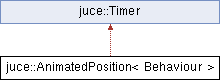
class juce::AnimatedPosition< Behaviour >
Models a 1-dimensional position that can be dragged around by the user, and which will then continue moving with a customisable physics behaviour when released.
This is useful for things like scrollable views or objects that can be dragged and thrown around with the mouse/touch, and by writing your own behaviour class, you can customise the trajectory that it follows when released.
The class uses its own Timer to continuously change its value when a drag ends, and Listener objects can be registered to receive callbacks whenever the value changes.
The value is stored as a double, and can be used to represent whatever units you need.
The template parameter Behaviour must be a class that implements various methods to return the physics of the value's movement - you can use the classes provided for this in the AnimatedPositionBehaviours namespace, or write your own custom behaviour.
- See also
- AnimatedPositionBehaviours::ContinuousWithMomentum, AnimatedPositionBehaviours::SnapToPageBoundaries
@tags{GUI}
Constructor & Destructor Documentation
◆ AnimatedPosition()
|
inline |
Member Function Documentation
◆ addListener()
|
inline |
Adds a listener to be called when the value changes.
◆ beginDrag()
|
inline |
Called to indicate that the object is now being controlled by a mouse-drag or similar operation.
After calling this method, you should make calls to the drag() method each time the mouse drags the position around, and always be sure to finish with a call to endDrag() when the mouse is released, which allows the position to continue moving freely according to the specified behaviour.
◆ drag()
|
inline |
Called during a mouse-drag operation, to indicate that the mouse has moved. The delta is the difference between the position when beginDrag() was called and the new position that's required.
◆ endDrag()
|
inline |
Called after beginDrag() and drag() to indicate that the drag operation has now finished.
◆ getPosition()
|
inlinenoexcept |
Returns the current position.
◆ getSpeed()
|
inlinestaticprivate |
◆ moveTo()
|
inlineprivate |
◆ nudge()
|
inline |
Called outside of a drag operation to cause a nudge in the specified direction. This is intended for use by e.g. mouse-wheel events.
◆ removeListener()
|
inline |
Removes a previously-registered listener.
◆ setLimits()
|
inlinenoexcept |
Sets a range within which the value will be constrained.
◆ setPosition()
|
inline |
Explicitly sets the position and stops any further movement. This will cause a synchronous call to any listeners if the position actually changes.
◆ setPositionAndSendChange()
|
inlineprivate |
◆ timerCallback()
|
inlineoverrideprivatevirtual |
The user-defined callback routine that actually gets called periodically.
It's perfectly ok to call startTimer() or stopTimer() from within this callback to change the subsequent intervals.
Implements juce::Timer.
Member Data Documentation
◆ behaviour
| Behaviour juce::AnimatedPosition< Behaviour >::behaviour |
The behaviour object. This is public to let you tweak any parameters that it provides.
◆ grabbedPos
|
private |
◆ lastDrag
|
private |
◆ lastUpdate
|
private |
◆ listeners
|
private |
◆ position
|
private |
◆ range
|
private |
◆ releaseVelocity
|
private |
The documentation for this class was generated from the following file:
- /home/runner/work/lmms-fork/lmms-fork/plugins/CarlaBase/carla/source/modules/juce_gui_basics/layout/juce_AnimatedPosition.h
Generated on for LMMS by
 1.16.1