◆ ASIOAudioIODevice()
◆ ~ASIOAudioIODevice()
| juce::ASIOAudioIODevice::~ASIOAudioIODevice |
( |
| ) |
|
|
inline |
◆ addBufferSizes()
| void juce::ASIOAudioIODevice::addBufferSizes |
( |
long | minSize, |
|
|
long | maxSize, |
|
|
long | preferredSize, |
|
|
long | granularity ) |
|
inlineprivate |
◆ asioMessagesCallback()
| long juce::ASIOAudioIODevice::asioMessagesCallback |
( |
long | selector, |
|
|
long | value ) |
|
inlineprivate |
◆ callback()
◆ close()
| void juce::ASIOAudioIODevice::close |
( |
| ) |
|
|
inlineoverridevirtual |
◆ convertASIOString()
| String juce::ASIOAudioIODevice::convertASIOString |
( |
char * | text, |
|
|
int | length ) |
|
inlinestaticprivate |
◆ createDummyBuffers()
| void juce::ASIOAudioIODevice::createDummyBuffers |
( |
long | preferredSize | ) |
|
|
inlineprivate |
◆ disposeBuffers()
| void juce::ASIOAudioIODevice::disposeBuffers |
( |
| ) |
|
|
inlineprivate |
◆ getActiveInputChannels()
| BigInteger juce::ASIOAudioIODevice::getActiveInputChannels |
( |
| ) |
const |
|
inlineoverridevirtual |
Returns a mask showing which of the available input channels are currently enabled.
- See also
- getInputChannelNames
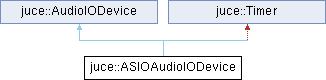
Implements juce::AudioIODevice.
◆ getActiveOutputChannels()
| BigInteger juce::ASIOAudioIODevice::getActiveOutputChannels |
( |
| ) |
const |
|
inlineoverridevirtual |
Returns a mask showing which of the available output channels are currently enabled.
- See also
- getOutputChannelNames
Implements juce::AudioIODevice.
◆ getAvailableBufferSizes()
| Array< int > juce::ASIOAudioIODevice::getAvailableBufferSizes |
( |
| ) |
|
|
inlineoverridevirtual |
Returns the set of buffer sizes that are available.
- See also
- getCurrentBufferSizeSamples, getDefaultBufferSize
Implements juce::AudioIODevice.
◆ getAvailableSampleRates()
| Array< double > juce::ASIOAudioIODevice::getAvailableSampleRates |
( |
| ) |
|
|
inlineoverridevirtual |
Returns the set of sample-rates this device supports.
- See also
- getCurrentSampleRate
Implements juce::AudioIODevice.
◆ getChannelName()
| String juce::ASIOAudioIODevice::getChannelName |
( |
int | index, |
|
|
bool | isInput ) const |
|
inlineprivate |
◆ getCurrentBitDepth()
| int juce::ASIOAudioIODevice::getCurrentBitDepth |
( |
| ) |
|
|
inlineoverridevirtual |
Returns the device's current physical bit-depth.
If the device isn't actually open, this value doesn't really mean much.
Implements juce::AudioIODevice.
◆ getCurrentBufferSizeSamples()
| int juce::ASIOAudioIODevice::getCurrentBufferSizeSamples |
( |
| ) |
|
|
inlineoverridevirtual |
Returns the buffer size that the device is currently using.
If the device isn't actually open, this value doesn't really mean much.
Implements juce::AudioIODevice.
◆ getCurrentSampleRate()
| double juce::ASIOAudioIODevice::getCurrentSampleRate |
( |
| ) |
|
|
inlineoverridevirtual |
Returns the sample rate that the device is currently using.
If the device isn't actually open, this value doesn't really mean much.
Implements juce::AudioIODevice.
◆ getDefaultBufferSize()
| int juce::ASIOAudioIODevice::getDefaultBufferSize |
( |
| ) |
|
|
inlineoverridevirtual |
Returns the default buffer-size to use.
- Returns
- a number of samples
- See also
- getAvailableBufferSizes
Implements juce::AudioIODevice.
◆ getInputChannelNames()
| StringArray juce::ASIOAudioIODevice::getInputChannelNames |
( |
| ) |
|
|
inlineoverridevirtual |
Returns the names of all the available input channels on this device. To find out which of these are currently in use, call getActiveInputChannels().
Implements juce::AudioIODevice.
◆ getInputLatencyInSamples()
| int juce::ASIOAudioIODevice::getInputLatencyInSamples |
( |
| ) |
|
|
inlineoverridevirtual |
Returns the device's input latency.
This is the delay in samples between some audio actually arriving at the soundcard, and the callback getting passed this block of data.
Implements juce::AudioIODevice.
◆ getLastDriverError()
| String juce::ASIOAudioIODevice::getLastDriverError |
( |
| ) |
const |
|
inlineprivate |
◆ getLastError()
| String juce::ASIOAudioIODevice::getLastError |
( |
| ) |
|
|
inlineoverridevirtual |
◆ getOutputChannelNames()
| StringArray juce::ASIOAudioIODevice::getOutputChannelNames |
( |
| ) |
|
|
inlineoverridevirtual |
Returns the names of all the available output channels on this device. To find out which of these are currently in use, call getActiveOutputChannels().
Implements juce::AudioIODevice.
◆ getOutputLatencyInSamples()
| int juce::ASIOAudioIODevice::getOutputLatencyInSamples |
( |
| ) |
|
|
inlineoverridevirtual |
Returns the device's output latency.
This is the delay in samples between a callback getting a block of data, and that data actually getting played.
Implements juce::AudioIODevice.
◆ getSampleRate()
| double juce::ASIOAudioIODevice::getSampleRate |
( |
| ) |
const |
|
inlineprivate |
◆ getXRunCount()
| int juce::ASIOAudioIODevice::getXRunCount |
( |
| ) |
const |
|
inlineoverridevirtualnoexcept |
Returns the number of under- or over runs reported by the OS since playback/recording has started.
This number may be different than determining the Xrun count manually (by measuring the time spent in the audio callback) as the OS may be doing some buffering internally - especially on mobile devices.
Returns -1 if playback/recording has not started yet or if getting the underrun count is not supported for this device (Android SDK 23 and lower).
Reimplemented from juce::AudioIODevice.
◆ hasControlPanel()
| bool juce::ASIOAudioIODevice::hasControlPanel |
( |
| ) |
const |
|
inlineoverridevirtual |
True if this device can show a pop-up control panel for editing its settings.
This is generally just true of ASIO devices. If true, you can call showControlPanel() to display it.
Reimplemented from juce::AudioIODevice.
◆ initDriver()
| String juce::ASIOAudioIODevice::initDriver |
( |
| ) |
|
|
inlineprivate |
◆ isOpen()
| bool juce::ASIOAudioIODevice::isOpen |
( |
| ) |
|
|
inlineoverridevirtual |
Returns true if the device is still open.
A device might spontaneously close itself if something goes wrong, so this checks if it's still open.
Implements juce::AudioIODevice.
◆ isPlaying()
| bool juce::ASIOAudioIODevice::isPlaying |
( |
| ) |
|
|
inlineoverridevirtual |
Returns true if the device is still calling back.
The device might mysteriously stop, so this checks whether it's still playing.
Implements juce::AudioIODevice.
◆ loadDriver()
| bool juce::ASIOAudioIODevice::loadDriver |
( |
| ) |
|
|
inlineprivate |
◆ open()
Tries to open the device ready to play.
- Parameters
-
| inputChannels | a BigInteger in which a set bit indicates that the corresponding input channel should be enabled |
| outputChannels | a BigInteger in which a set bit indicates that the corresponding output channel should be enabled |
| sampleRate | the sample rate to try to use - to find out which rates are available, see getAvailableSampleRates() |
| bufferSizeSamples | the size of i/o buffer to use - to find out the available buffer sizes, see getAvailableBufferSizes() |
- Returns
- an error description if there's a problem, or an empty string if it succeeds in opening the device
- See also
- close
Implements juce::AudioIODevice.
◆ openDevice()
| String juce::ASIOAudioIODevice::openDevice |
( |
| ) |
|
|
inlineprivate |
◆ processBuffer()
| void juce::ASIOAudioIODevice::processBuffer |
( |
long | bufferIndex | ) |
|
|
inlineprivate |
◆ readBufferSizes()
| int juce::ASIOAudioIODevice::readBufferSizes |
( |
int | bufferSizeSamples | ) |
|
|
inlineprivate |
◆ readLatencies()
| void juce::ASIOAudioIODevice::readLatencies |
( |
| ) |
|
|
inlineprivate |
◆ refreshBufferSizes()
| long juce::ASIOAudioIODevice::refreshBufferSizes |
( |
| ) |
|
|
inlineprivate |
◆ reloadChannelNames()
| void juce::ASIOAudioIODevice::reloadChannelNames |
( |
| ) |
|
|
inlineprivate |
◆ removeCurrentDriver()
| bool juce::ASIOAudioIODevice::removeCurrentDriver |
( |
| ) |
|
|
inlineprivate |
◆ resetBuffers()
◆ resetRequest()
| void juce::ASIOAudioIODevice::resetRequest |
( |
| ) |
|
|
inlinenoexcept |
◆ setCallbackFunctions()
| void juce::ASIOAudioIODevice::setCallbackFunctions |
( |
| ) |
|
|
inlineprivatenoexcept |
◆ setSampleRate()
| void juce::ASIOAudioIODevice::setSampleRate |
( |
double | newRate | ) |
|
|
inlineprivate |
◆ showControlPanel()
| bool juce::ASIOAudioIODevice::showControlPanel |
( |
| ) |
|
|
inlineoverridevirtual |
Shows a device-specific control panel if there is one.
This should only be called for devices which return true from hasControlPanel().
Reimplemented from juce::AudioIODevice.
◆ start()
◆ stop()
| void juce::ASIOAudioIODevice::stop |
( |
| ) |
|
|
inlineoverridevirtual |
Stops the device playing.
Once a device has been started, this will stop it. Any pending calls to the callback class will be flushed before this method returns.
Implements juce::AudioIODevice.
◆ timerCallback()
| void juce::ASIOAudioIODevice::timerCallback |
( |
| ) |
|
|
inlineoverridevirtual |
The user-defined callback routine that actually gets called periodically.
It's perfectly ok to call startTimer() or stopTimer() from within this callback to change the subsequent intervals.
Implements juce::Timer.
◆ tryCreatingDriver()
| bool juce::ASIOAudioIODevice::tryCreatingDriver |
( |
bool & | crashed | ) |
|
|
inlineprivate |
◆ updateClockSources()
| void juce::ASIOAudioIODevice::updateClockSources |
( |
| ) |
|
|
inlineprivate |
◆ updateSampleRates()
| void juce::ASIOAudioIODevice::updateSampleRates |
( |
| ) |
|
|
inline |
◆ asioObject
| IASIO* juce::ASIOAudioIODevice::asioObject = {} |
|
private |
◆ bufferGranularity
| long juce::ASIOAudioIODevice::bufferGranularity = 0 |
|
private |
◆ bufferInfos
◆ buffersCreated
| bool juce::ASIOAudioIODevice::buffersCreated = false |
|
private |
◆ bufferSizes
| Array<int> juce::ASIOAudioIODevice::bufferSizes |
|
private |
◆ callbackLock
◆ callbacks
◆ calledback
| std::atomic<bool> juce::ASIOAudioIODevice::calledback { false } |
|
private |
◆ classId
| CLSID juce::ASIOAudioIODevice::classId |
|
private |
◆ clocks
◆ currentBitDepth
| int juce::ASIOAudioIODevice::currentBitDepth = 16 |
|
private |
◆ currentBlockSizeSamples
| int juce::ASIOAudioIODevice::currentBlockSizeSamples = 0 |
|
private |
◆ currentCallback
◆ currentChansIn
| BigInteger juce::ASIOAudioIODevice::currentChansIn |
|
private |
◆ currentChansOut
| BigInteger juce::ASIOAudioIODevice::currentChansOut |
|
private |
◆ currentSampleRate
| double juce::ASIOAudioIODevice::currentSampleRate = 0 |
|
private |
◆ deviceIsOpen
| bool juce::ASIOAudioIODevice::deviceIsOpen = false |
|
private |
◆ error
| String juce::ASIOAudioIODevice::error |
|
private |
◆ inBuffers
| HeapBlock<float*> juce::ASIOAudioIODevice::inBuffers |
|
private |
◆ inputChannelNames
◆ inputFormat
◆ inputLatency
| long juce::ASIOAudioIODevice::inputLatency = 0 |
|
private |
◆ insideControlPanelModalLoop
| bool juce::ASIOAudioIODevice::insideControlPanelModalLoop = false |
|
private |
◆ ioBufferSpace
| HeapBlock<float> juce::ASIOAudioIODevice::ioBufferSpace |
|
private |
◆ isStarted
| bool juce::ASIOAudioIODevice::isStarted = false |
|
private |
◆ maxBufferSize
| long juce::ASIOAudioIODevice::maxBufferSize = 0 |
|
private |
◆ minBufferSize
| long juce::ASIOAudioIODevice::minBufferSize = 0 |
|
private |
◆ needToReset
| bool juce::ASIOAudioIODevice::needToReset = false |
|
private |
◆ numActiveInputChans
| int juce::ASIOAudioIODevice::numActiveInputChans = 0 |
|
private |
◆ numActiveOutputChans
| int juce::ASIOAudioIODevice::numActiveOutputChans = 0 |
|
private |
◆ numClockSources
| int juce::ASIOAudioIODevice::numClockSources = 0 |
|
private |
◆ outBuffers
| HeapBlock<float*> juce::ASIOAudioIODevice::outBuffers |
|
private |
◆ outputChannelNames
| StringArray juce::ASIOAudioIODevice::outputChannelNames |
|
private |
◆ outputFormat
◆ outputLatency
| long juce::ASIOAudioIODevice::outputLatency = 0 |
|
private |
◆ owner
◆ postOutput
| bool juce::ASIOAudioIODevice::postOutput = true |
|
private |
◆ preferredBufferSize
| long juce::ASIOAudioIODevice::preferredBufferSize = 0 |
|
private |
◆ sampleRates
| Array<double> juce::ASIOAudioIODevice::sampleRates |
|
private |
◆ shouldUsePreferredSize
| bool juce::ASIOAudioIODevice::shouldUsePreferredSize = false |
|
private |
◆ totalNumInputChans
| long juce::ASIOAudioIODevice::totalNumInputChans = 0 |
|
private |
◆ totalNumOutputChans
| long juce::ASIOAudioIODevice::totalNumOutputChans = 0 |
|
private |
◆ xruns
| int juce::ASIOAudioIODevice::xruns = 0 |
|
private |
The documentation for this class was generated from the following file:
- /home/runner/work/lmms-fork/lmms-fork/plugins/CarlaBase/carla/source/modules/juce_audio_devices/native/juce_win32_ASIO.cpp
 1.16.1