juce::dsp::LogRampedValue< FloatType > Class Template Reference
#include <juce_LogRampedValue.h>
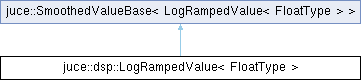
Inheritance diagram for juce::dsp::LogRampedValue< FloatType >:
Public Member Functions | |
| LogRampedValue ()=default | |
| LogRampedValue (FloatType initialValue) noexcept | |
| void | setLogParameters (FloatType midPointAmplitudedB, bool rateOfChangeShouldIncrease) noexcept |
| void | reset (double sampleRate, double rampLengthInSeconds) noexcept |
| void | reset (int numSteps) noexcept |
| void | setTargetValue (FloatType newValue) noexcept |
| FloatType | getNextValue () noexcept |
| FloatType | skip (int numSamples) noexcept |
| Public Member Functions inherited from juce::SmoothedValueBase< LogRampedValue< FloatType > > | |
| SmoothedValueBase ()=default | |
| bool | isSmoothing () const noexcept |
| FloatType | getCurrentValue () const noexcept |
| FloatType | getTargetValue () const noexcept |
| void | setCurrentAndTargetValue (FloatType newValue) |
| void | applyGain (FloatType *samples, int numSamples) noexcept |
Private Member Functions | |
| void | updateRampParameters () |
Private Attributes | |
| bool | increasingRateOfChange = true |
| FloatType | B = Decibels::decibelsToGain ((FloatType) -40) |
| int | stepsToTarget = 0 |
| FloatType | temp = 0 |
| FloatType | source = 0 |
| FloatType | r = 0 |
| FloatType | d = 1 |
Additional Inherited Members | |
| Public Types inherited from juce::SmoothedValueBase< LogRampedValue< FloatType > > | |
| using | FloatType |
| Protected Attributes inherited from juce::SmoothedValueBase< LogRampedValue< FloatType > > | |
| FloatType | currentValue |
| FloatType | target |
| int | countdown |
Detailed Description
template<typename FloatType>
class juce::dsp::LogRampedValue< FloatType >
class juce::dsp::LogRampedValue< FloatType >
Utility class for logarithmically smoothed linear values.
Logarithmically smoothed values can be more relevant than linear ones for specific cases such as algorithm change smoothing, using two of them in opposite directions.
The gradient of the logarithmic/exponential slope can be configured by calling LogRampedValue::setLogParameters.
- See also
- SmoothedValue
@tags{DSP}
Constructor & Destructor Documentation
◆ LogRampedValue() [1/2]
template<typename FloatType>
|
default |
Constructor.
◆ LogRampedValue() [2/2]
template<typename FloatType>
|
inlinenoexcept |
Constructor.
Member Function Documentation
◆ getNextValue()
template<typename FloatType>
|
inlinenoexcept |
Compute the next value.
- Returns
- Smoothed value
◆ reset() [1/2]
template<typename FloatType>
|
inlinenoexcept |
Reset to a new sample rate and ramp length.
- Parameters
-
sampleRate The sample rate rampLengthInSeconds The duration of the ramp in seconds
◆ reset() [2/2]
template<typename FloatType>
|
inlinenoexcept |
Set a new ramp length directly in samples.
- Parameters
-
numSteps The number of samples over which the ramp should be active
◆ setLogParameters()
template<typename FloatType>
|
inlinenoexcept |
Sets the behaviour of the log ramp.
- Parameters
-
midPointAmplitudedB Sets the amplitude of the mid point in decibels, with the target value at 0 dB and the initial value at -inf dB rateOfChangeShouldIncrease If true then the ramp starts shallow and gets progressively steeper, if false then the ramp is initially steep and flattens out as you approach the target value
◆ setTargetValue()
template<typename FloatType>
|
inlinenoexcept |
Set a new target value.
- Parameters
-
newValue The new target value
◆ skip()
template<typename FloatType>
|
inlinenoexcept |
Skip the next numSamples samples.
This is identical to calling getNextValue numSamples times.
- See also
- getNextValue
◆ updateRampParameters()
template<typename FloatType>
|
inlineprivate |
Member Data Documentation
◆ B
template<typename FloatType>
|
private |
◆ d
template<typename FloatType>
|
private |
◆ increasingRateOfChange
template<typename FloatType>
|
private |
◆ r
template<typename FloatType>
|
private |
◆ source
template<typename FloatType>
|
private |
◆ stepsToTarget
template<typename FloatType>
|
private |
◆ temp
template<typename FloatType>
|
private |
The documentation for this class was generated from the following file:
- /home/runner/work/lmms-fork/lmms-fork/plugins/CarlaBase/carla/source/modules/juce_dsp/maths/juce_LogRampedValue.h
Generated on for LMMS by
 1.16.1