#include <juce_ValueTreeSynchroniser.h>
Public Member Functions | |
| ValueTreeSynchroniser (const ValueTree &tree) | |
| ~ValueTreeSynchroniser () override | |
| virtual void | stateChanged (const void *encodedChange, size_t encodedChangeSize)=0 |
| void | sendFullSyncCallback () |
| const ValueTree & | getRoot () noexcept |
Static Public Member Functions | |
| static bool | applyChange (ValueTree &target, const void *encodedChangeData, size_t encodedChangeDataSize, UndoManager *undoManager) |
Private Member Functions | |
| void | valueTreePropertyChanged (ValueTree &, const Identifier &) override |
| void | valueTreeChildAdded (ValueTree &, ValueTree &) override |
| void | valueTreeChildRemoved (ValueTree &, ValueTree &, int) override |
| void | valueTreeChildOrderChanged (ValueTree &, int, int) override |
| Private Member Functions inherited from juce::ValueTree::Listener | |
| virtual | ~Listener ()=default |
| virtual void | valueTreeParentChanged (ValueTree &treeWhoseParentHasChanged) |
| virtual void | valueTreeRedirected (ValueTree &treeWhichHasBeenChanged) |
Private Attributes | |
| ValueTree | valueTree |
Detailed Description
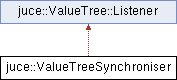
This class can be used to watch for all changes to the state of a ValueTree, and to convert them to a transmittable binary encoding.
The purpose of this class is to allow two or more ValueTrees to be remotely synchronised by transmitting encoded changes over some kind of transport mechanism.
To use it, you'll need to implement a subclass of ValueTreeSynchroniser and implement the stateChanged() method to transmit the encoded change (maybe via a network or other means) to a remote destination, where it can be applied to a target tree.
@tags{DataStructures}
Constructor & Destructor Documentation
◆ ValueTreeSynchroniser()
Creates a ValueTreeSynchroniser that watches the given tree.
After creating an instance of this class and somehow attaching it to a target tree, you probably want to call sendFullSyncCallback() to get them into a common starting state.
◆ ~ValueTreeSynchroniser()
|
override |
Destructor.
Member Function Documentation
◆ applyChange()
|
static |
Applies an encoded change to the given destination tree.
When you implement a receiver for changes that were sent by the stateChanged() message, this is the function that you'll need to call to apply them to the target tree that you want to be synced.
◆ getRoot()
Returns the root ValueTree that is being observed.
◆ sendFullSyncCallback()
| void juce::ValueTreeSynchroniser::sendFullSyncCallback | ( | ) |
Forces the sending of a full state message, which may be large, as it encodes the entire ValueTree.
This will internally invoke stateChanged() with the encoded version of the state.
◆ stateChanged()
|
pure virtual |
This callback happens when the ValueTree changes and the given state-change message needs to be applied to any other trees that need to stay in sync with it. The data is an opaque blob of binary that you should transmit to wherever your target tree lives, and use applyChange() to apply this to the target tree.
◆ valueTreeChildAdded()
|
overrideprivatevirtual |
This method is called when a child sub-tree is added. Note that when you register a listener to a tree, it will receive this callback for child changes in both that tree and any of its children, (recursively, at any depth). If your tree has sub-trees but you only want to know about changes to the top level tree, just check the parentTree parameter to make sure it's the one that you're interested in.
Reimplemented from juce::ValueTree::Listener.
◆ valueTreeChildOrderChanged()
|
overrideprivatevirtual |
This method is called when a tree's children have been re-shuffled.
Note that when you register a listener to a tree, it will receive this callback for child changes in both that tree and any of its children, (recursively, at any depth). If your tree has sub-trees but you only want to know about changes to the top level tree, just check the parameter to make sure it's the tree that you're interested in.
Reimplemented from juce::ValueTree::Listener.
◆ valueTreeChildRemoved()
|
overrideprivatevirtual |
This method is called when a child sub-tree is removed.
Note that when you register a listener to a tree, it will receive this callback for child changes in both that tree and any of its children, (recursively, at any depth). If your tree has sub-trees but you only want to know about changes to the top level tree, just check the parentTree parameter to make sure it's the one that you're interested in.
Reimplemented from juce::ValueTree::Listener.
◆ valueTreePropertyChanged()
|
overrideprivatevirtual |
This method is called when a property of this tree (or of one of its sub-trees) is changed. Note that when you register a listener to a tree, it will receive this callback for property changes in that tree, and also for any of its children, (recursively, at any depth). If your tree has sub-trees but you only want to know about changes to the top level tree, simply check the tree parameter in this callback to make sure it's the tree you're interested in.
Reimplemented from juce::ValueTree::Listener.
Member Data Documentation
◆ valueTree
|
private |
The documentation for this class was generated from the following files:
- /home/runner/work/lmms-fork/lmms-fork/plugins/CarlaBase/carla/source/modules/juce_data_structures/values/juce_ValueTreeSynchroniser.h
- /home/runner/work/lmms-fork/lmms-fork/plugins/CarlaBase/carla/source/modules/juce_data_structures/values/juce_ValueTreeSynchroniser.cpp
Generated on for LMMS by
 1.16.1