#include <juce_ResamplingAudioSource.h>
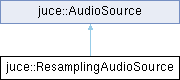
A type of AudioSource that takes an input source and changes its sample rate.
- See also
- AudioSource, LagrangeInterpolator, CatmullRomInterpolator
@tags{Audio}
◆ ResamplingAudioSource()
| juce::ResamplingAudioSource::ResamplingAudioSource |
( |
AudioSource * | inputSource, |
|
|
bool | deleteInputWhenDeleted, |
|
|
int | numChannels = 2 ) |
Creates a ResamplingAudioSource for a given input source.
- Parameters
-
| inputSource | the input source to read from |
| deleteInputWhenDeleted | if true, the input source will be deleted when this object is deleted |
| numChannels | the number of channels to process |
◆ ~ResamplingAudioSource()
| juce::ResamplingAudioSource::~ResamplingAudioSource |
( |
| ) |
|
|
override |
◆ applyFilter()
| void juce::ResamplingAudioSource::applyFilter |
( |
float * | samples, |
|
|
int | num, |
|
|
FilterState & | fs ) |
|
private |
◆ createLowPass()
| void juce::ResamplingAudioSource::createLowPass |
( |
double | proportionalRate | ) |
|
|
private |
◆ flushBuffers()
| void juce::ResamplingAudioSource::flushBuffers |
( |
| ) |
|
Clears any buffers and filters that the resampler is using.
◆ getNextAudioBlock()
Called repeatedly to fetch subsequent blocks of audio data.
After calling the prepareToPlay() method, this callback will be made each time the audio playback hardware (or whatever other destination the audio data is going to) needs another block of data.
It will generally be called on a high-priority system thread, or possibly even an interrupt, so be careful not to do too much work here, as that will cause audio glitches!
- See also
- AudioSourceChannelInfo, prepareToPlay, releaseResources
Implements juce::AudioSource.
◆ getResamplingRatio()
| double juce::ResamplingAudioSource::getResamplingRatio |
( |
| ) |
const |
|
inlinenoexcept |
Returns the current resampling ratio.
This is the value that was set by setResamplingRatio().
◆ prepareToPlay()
| void juce::ResamplingAudioSource::prepareToPlay |
( |
int | samplesPerBlockExpected, |
|
|
double | sampleRate ) |
|
overridevirtual |
Tells the source to prepare for playing.
An AudioSource has two states: prepared and unprepared.
The prepareToPlay() method is guaranteed to be called at least once on an 'unprepared' source to put it into a 'prepared' state before any calls will be made to getNextAudioBlock(). This callback allows the source to initialise any resources it might need when playing.
Once playback has finished, the releaseResources() method is called to put the stream back into an 'unprepared' state.
Note that this method could be called more than once in succession without a matching call to releaseResources(), so make sure your code is robust and can handle that kind of situation.
- Parameters
-
| samplesPerBlockExpected | the number of samples that the source will be expected to supply each time its getNextAudioBlock() method is called. This number may vary slightly, because it will be dependent on audio hardware callbacks, and these aren't guaranteed to always use a constant block size, so the source should be able to cope with small variations. |
| sampleRate | the sample rate that the output will be used at - this is needed by sources such as tone generators. |
- See also
- releaseResources, getNextAudioBlock
Implements juce::AudioSource.
◆ releaseResources()
| void juce::ResamplingAudioSource::releaseResources |
( |
| ) |
|
|
overridevirtual |
Allows the source to release anything it no longer needs after playback has stopped.
This will be called when the source is no longer going to have its getNextAudioBlock() method called, so it should release any spare memory, etc. that it might have allocated during the prepareToPlay() call.
Note that there's no guarantee that prepareToPlay() will actually have been called before releaseResources(), and it may be called more than once in succession, so make sure your code is robust and doesn't make any assumptions about when it will be called.
- See also
- prepareToPlay, getNextAudioBlock
Implements juce::AudioSource.
◆ resetFilters()
| void juce::ResamplingAudioSource::resetFilters |
( |
| ) |
|
|
private |
◆ setFilterCoefficients()
| void juce::ResamplingAudioSource::setFilterCoefficients |
( |
double | c1, |
|
|
double | c2, |
|
|
double | c3, |
|
|
double | c4, |
|
|
double | c5, |
|
|
double | c6 ) |
|
private |
◆ setResamplingRatio()
| void juce::ResamplingAudioSource::setResamplingRatio |
( |
double | samplesInPerOutputSample | ) |
|
Changes the resampling ratio.
(This value can be changed at any time, even while the source is running).
- Parameters
-
| samplesInPerOutputSample | if set to 1.0, the input is passed through; higher values will speed it up; lower values will slow it down. The ratio must be greater than 0 |
◆ buffer
◆ bufferPos
| int juce::ResamplingAudioSource::bufferPos = 0 |
|
private |
◆ callbackLock
◆ coefficients
| double juce::ResamplingAudioSource::coefficients[6] |
|
private |
◆ destBuffers
| HeapBlock<float*> juce::ResamplingAudioSource::destBuffers |
|
private |
◆ filterStates
◆ input
◆ lastRatio
| double juce::ResamplingAudioSource::lastRatio = 1.0 |
|
private |
◆ numChannels
| const int juce::ResamplingAudioSource::numChannels |
|
private |
◆ ratio
| double juce::ResamplingAudioSource::ratio = 1.0 |
|
private |
◆ ratioLock
| SpinLock juce::ResamplingAudioSource::ratioLock |
|
private |
◆ sampsInBuffer
| int juce::ResamplingAudioSource::sampsInBuffer = 0 |
|
private |
◆ srcBuffers
◆ subSampleOffset
| double juce::ResamplingAudioSource::subSampleOffset = 0.0 |
|
private |
The documentation for this class was generated from the following files:
 1.16.1