#include <juce_MixerAudioSource.h>
Public Member Functions | |
| MixerAudioSource () | |
| ~MixerAudioSource () override | |
| void | addInputSource (AudioSource *newInput, bool deleteWhenRemoved) |
| void | removeInputSource (AudioSource *input) |
| void | removeAllInputs () |
| void | prepareToPlay (int samplesPerBlockExpected, double sampleRate) override |
| void | releaseResources () override |
| void | getNextAudioBlock (const AudioSourceChannelInfo &) override |
| Public Member Functions inherited from juce::AudioSource | |
| virtual | ~AudioSource ()=default |
Private Attributes | |
| Array< AudioSource * > | inputs |
| BigInteger | inputsToDelete |
| CriticalSection | lock |
| AudioBuffer< float > | tempBuffer |
| double | currentSampleRate |
| int | bufferSizeExpected |
Additional Inherited Members | |
| Protected Member Functions inherited from juce::AudioSource | |
| AudioSource ()=default | |
Detailed Description
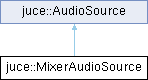
An AudioSource that mixes together the output of a set of other AudioSources.
Input sources can be added and removed while the mixer is running as long as their prepareToPlay() and releaseResources() methods are called before and after adding them to the mixer.
@tags{Audio}
Constructor & Destructor Documentation
◆ MixerAudioSource()
| juce::MixerAudioSource::MixerAudioSource | ( | ) |
Creates a MixerAudioSource.
◆ ~MixerAudioSource()
|
override |
Destructor.
Member Function Documentation
◆ addInputSource()
| void juce::MixerAudioSource::addInputSource | ( | AudioSource * | newInput, |
| bool | deleteWhenRemoved ) |
Adds an input source to the mixer.
If the mixer is running you'll need to make sure that the input source is ready to play by calling its prepareToPlay() method before adding it. If the mixer is stopped, then its input sources will be automatically prepared when the mixer's prepareToPlay() method is called.
- Parameters
-
newInput the source to add to the mixer deleteWhenRemoved if true, then this source will be deleted when no longer needed by the mixer.
◆ getNextAudioBlock()
|
overridevirtual |
Implementation of the AudioSource method.
Implements juce::AudioSource.
◆ prepareToPlay()
|
overridevirtual |
Implementation of the AudioSource method. This will call prepareToPlay() on all its input sources.
Implements juce::AudioSource.
◆ releaseResources()
|
overridevirtual |
Implementation of the AudioSource method. This will call releaseResources() on all its input sources.
Implements juce::AudioSource.
◆ removeAllInputs()
| void juce::MixerAudioSource::removeAllInputs | ( | ) |
Removes all the input sources. Any sources which were added by calling addInputSource() with the deleteWhenRemoved flag set will be deleted by this method.
◆ removeInputSource()
| void juce::MixerAudioSource::removeInputSource | ( | AudioSource * | input | ) |
Removes an input source. If the source was added by calling addInputSource() with the deleteWhenRemoved flag set, it will be deleted by this method.
Member Data Documentation
◆ bufferSizeExpected
|
private |
◆ currentSampleRate
|
private |
◆ inputs
|
private |
◆ inputsToDelete
|
private |
◆ lock
|
private |
◆ tempBuffer
|
private |
The documentation for this class was generated from the following files:
- /home/runner/work/lmms-fork/lmms-fork/plugins/CarlaBase/carla/source/modules/juce_audio_basics/sources/juce_MixerAudioSource.h
- /home/runner/work/lmms-fork/lmms-fork/plugins/CarlaBase/carla/source/modules/juce_audio_basics/sources/juce_MixerAudioSource.cpp
Generated on for LMMS by
 1.16.1