#include <juce_FileLogger.h>
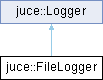
Public Member Functions | |
| FileLogger (const File &fileToWriteTo, const String &welcomeMessage, const int64 maxInitialFileSizeBytes=128 *1024) | |
| ~FileLogger () override | |
| const File & | getLogFile () const noexcept |
| void | logMessage (const String &) override |
| Public Member Functions inherited from juce::Logger | |
| virtual | ~Logger () |
Static Public Member Functions | |
| static FileLogger * | createDefaultAppLogger (const String &logFileSubDirectoryName, const String &logFileName, const String &welcomeMessage, const int64 maxInitialFileSizeBytes=128 *1024) |
| static FileLogger * | createDateStampedLogger (const String &logFileSubDirectoryName, const String &logFileNameRoot, const String &logFileNameSuffix, const String &welcomeMessage) |
| static File | getSystemLogFileFolder () |
| static void | trimFileSize (const File &file, int64 maxFileSize) |
| Static Public Member Functions inherited from juce::Logger | |
| static void JUCE_CALLTYPE | setCurrentLogger (Logger *newLogger) noexcept |
| static Logger *JUCE_CALLTYPE | getCurrentLogger () noexcept |
| static void JUCE_CALLTYPE | writeToLog (const String &message) |
| static void JUCE_CALLTYPE | outputDebugString (const String &text) |
Private Attributes | |
| File | logFile |
| CriticalSection | logLock |
Additional Inherited Members | |
| Protected Member Functions inherited from juce::Logger | |
| Logger () | |
Detailed Description
Constructor & Destructor Documentation
◆ FileLogger()
| juce::FileLogger::FileLogger | ( | const File & | fileToWriteTo, |
| const String & | welcomeMessage, | ||
| const int64 | maxInitialFileSizeBytes = 128 * 1024 ) |
Creates a FileLogger for a given file.
- Parameters
-
fileToWriteTo the file that to use - new messages will be appended to the file. If the file doesn't exist, it will be created, along with any parent directories that are needed. welcomeMessage when opened, the logger will write a header to the log, along with the current date and time, and this welcome message maxInitialFileSizeBytes if this is zero or greater, then if the file already exists but is larger than this number of bytes, then the start of the file will be truncated to keep the size down. This prevents a log file getting ridiculously large over time. The file will be truncated at a new-line boundary. If this value is less than zero, no size limit will be imposed; if it's zero, the file will always be deleted. Note that the size is only checked once when this object is created - any logging that is done later will be appended without any checking
◆ ~FileLogger()
|
override |
Destructor.
Member Function Documentation
◆ createDateStampedLogger()
|
static |
Helper function to create a log file in the correct place for this platform.
The filename used is based on the root and suffix strings provided, along with a time and date string, meaning that a new, empty log file will be always be created rather than appending to an existing one.
The method might return nullptr if the file can't be created for some reason.
- Parameters
-
logFileSubDirectoryName the name of the subdirectory to create inside the logs folder (as returned by getSystemLogFileFolder). It's best to use something like the name of your application here. logFileNameRoot the start of the filename to use, e.g. "MyAppLog_". This will have a timestamp and the logFileNameSuffix appended to it logFileNameSuffix the file suffix to use, e.g. ".txt" welcomeMessage a message that will be written to the log when it's opened.
◆ createDefaultAppLogger()
|
static |
Helper function to create a log file in the correct place for this platform.
The method might return nullptr if the file can't be created for some reason.
- Parameters
-
logFileSubDirectoryName the name of the subdirectory to create inside the logs folder (as returned by getSystemLogFileFolder). It's best to use something like the name of your application here. logFileName the name of the file to create, e.g. "MyAppLog.txt". welcomeMessage a message that will be written to the log when it's opened. maxInitialFileSizeBytes (see the FileLogger constructor for more info on this)
◆ getLogFile()
Returns the file that this logger is writing to.
◆ getSystemLogFileFolder()
|
static |
Returns an OS-specific folder where log-files should be stored.
On Windows this will return a logger with a path such as: c:\Documents and Settings\username\Application Data\[logFileSubDirectoryName]\[logFileName]
On the Mac it'll create something like: ~/Library/Logs/[logFileSubDirectoryName]/[logFileName]
- See also
- createDefaultAppLogger
◆ logMessage()
This is overloaded by subclasses to implement custom logging behaviour.
- See also
- setCurrentLogger
Implements juce::Logger.
◆ trimFileSize()
This is a utility function which removes lines from the start of a text file to make sure that its total size is below the given size.
Member Data Documentation
◆ logFile
|
private |
◆ logLock
|
private |
The documentation for this class was generated from the following files:
- /home/runner/work/lmms-fork/lmms-fork/plugins/CarlaBase/carla/source/modules/juce_core/logging/juce_FileLogger.h
- /home/runner/work/lmms-fork/lmms-fork/plugins/CarlaBase/carla/source/modules/juce_core/logging/juce_FileLogger.cpp
Generated on for LMMS by
 1.16.1