#include <juce_AudioFormat.h>
Public Member Functions | |
| virtual | ~AudioFormat () |
| const String & | getFormatName () const |
| virtual StringArray | getFileExtensions () const |
| virtual bool | canHandleFile (const File &fileToTest) |
| virtual Array< int > | getPossibleSampleRates ()=0 |
| virtual Array< int > | getPossibleBitDepths ()=0 |
| virtual bool | canDoStereo ()=0 |
| virtual bool | canDoMono ()=0 |
| virtual bool | isCompressed () |
| virtual bool | isChannelLayoutSupported (const AudioChannelSet &channelSet) |
| virtual StringArray | getQualityOptions () |
| virtual AudioFormatReader * | createReaderFor (InputStream *sourceStream, bool deleteStreamIfOpeningFails)=0 |
| virtual MemoryMappedAudioFormatReader * | createMemoryMappedReader (const File &file) |
| virtual MemoryMappedAudioFormatReader * | createMemoryMappedReader (FileInputStream *fin) |
| virtual AudioFormatWriter * | createWriterFor (OutputStream *streamToWriteTo, double sampleRateToUse, unsigned int numberOfChannels, int bitsPerSample, const StringPairArray &metadataValues, int qualityOptionIndex)=0 |
| virtual AudioFormatWriter * | createWriterFor (OutputStream *streamToWriteTo, double sampleRateToUse, const AudioChannelSet &channelLayout, int bitsPerSample, const StringPairArray &metadataValues, int qualityOptionIndex) |
Protected Member Functions | |
| AudioFormat (String formatName, StringArray fileExtensions) | |
| AudioFormat (StringRef formatName, StringRef fileExtensions) | |
Private Attributes | |
| String | formatName |
| StringArray | fileExtensions |
Detailed Description
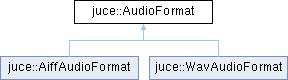
Subclasses of AudioFormat are used to read and write different audio file formats.
@tags{Audio}
Constructor & Destructor Documentation
◆ ~AudioFormat()
|
virtual |
Destructor.
◆ AudioFormat() [1/2]
|
protected |
Creates an AudioFormat object.
- Parameters
-
formatName this sets the value that will be returned by getFormatName() fileExtensions an array of file extensions - these will be returned by getFileExtensions()
◆ AudioFormat() [2/2]
Creates an AudioFormat object.
- Parameters
-
formatName this sets the value that will be returned by getFormatName() fileExtensions a whitespace-separated list of file extensions - these will be returned by getFileExtensions()
Member Function Documentation
◆ canDoMono()
|
pure virtual |
Returns true if the format can do 1-channel audio.
Implemented in juce::AiffAudioFormat, and juce::WavAudioFormat.
◆ canDoStereo()
|
pure virtual |
Returns true if the format can do 2-channel audio.
Implemented in juce::AiffAudioFormat, and juce::WavAudioFormat.
◆ canHandleFile()
Returns true if this the given file can be read by this format. Subclasses shouldn't do too much work here, just check the extension or file type. The base class implementation just checks the file's extension against one of the ones that was registered in the constructor.
◆ createMemoryMappedReader() [1/2]
|
virtual |
Attempts to create a MemoryMappedAudioFormatReader, if possible for this format. If the format does not support this, the method will return nullptr;
Reimplemented in juce::AiffAudioFormat, and juce::WavAudioFormat.
◆ createMemoryMappedReader() [2/2]
|
virtual |
Reimplemented in juce::AiffAudioFormat, and juce::WavAudioFormat.
◆ createReaderFor()
|
pure virtual |
Tries to create an object that can read from a stream containing audio data in this format.
The reader object that is returned can be used to read from the stream, and should then be deleted by the caller.
- Parameters
-
sourceStream the stream to read from - the AudioFormatReader object that is returned will delete this stream when it no longer needs it. deleteStreamIfOpeningFails if no reader can be created, this determines whether this method should delete the stream object that was passed-in. (If a valid reader is returned, it will always be in charge of deleting the stream, so this parameter is ignored)
- See also
- AudioFormatReader
Implemented in juce::AiffAudioFormat, and juce::WavAudioFormat.
◆ createWriterFor() [1/2]
|
virtual |
Tries to create an object that can write to a stream with this audio format.
The writer object that is returned can be used to write to the stream, and should then be deleted by the caller.
If the stream can't be created for some reason (e.g. the parameters passed in here aren't suitable), this will return nullptr.
- Parameters
-
streamToWriteTo the stream that the data will go to - this will be deleted by the AudioFormatWriter object when it's no longer needed. If no AudioFormatWriter can be created by this method, the stream will NOT be deleted, so that the caller can re-use it to try to open a different format, etc sampleRateToUse the sample rate for the file, which must be one of the ones returned by getPossibleSampleRates() channelLayout the channel layout for the file. Use isChannelLayoutSupported to check if the writer supports this layout. bitsPerSample the bits per sample to use - this must be one of the values returned by getPossibleBitDepths() metadataValues a set of metadata values that the writer should try to write to the stream. Exactly what these are depends on the format, and the subclass doesn't actually have to do anything with them if it doesn't want to. Have a look at the specific format implementation classes to see possible values that can be used qualityOptionIndex the index of one of compression qualities returned by the getQualityOptions() method. If there aren't any quality options for this format, just pass 0 in this parameter, as it'll be ignored
- See also
- AudioFormatWriter
Reimplemented in juce::AiffAudioFormat, and juce::WavAudioFormat.
◆ createWriterFor() [2/2]
|
pure virtual |
Tries to create an object that can write to a stream with this audio format.
The writer object that is returned can be used to write to the stream, and should then be deleted by the caller.
If the stream can't be created for some reason (e.g. the parameters passed in here aren't suitable), this will return nullptr.
- Parameters
-
streamToWriteTo the stream that the data will go to - this will be deleted by the AudioFormatWriter object when it's no longer needed. If no AudioFormatWriter can be created by this method, the stream will NOT be deleted, so that the caller can re-use it to try to open a different format, etc sampleRateToUse the sample rate for the file, which must be one of the ones returned by getPossibleSampleRates() numberOfChannels the number of channels bitsPerSample the bits per sample to use - this must be one of the values returned by getPossibleBitDepths() metadataValues a set of metadata values that the writer should try to write to the stream. Exactly what these are depends on the format, and the subclass doesn't actually have to do anything with them if it doesn't want to. Have a look at the specific format implementation classes to see possible values that can be used qualityOptionIndex the index of one of compression qualities returned by the getQualityOptions() method. If there aren't any quality options for this format, just pass 0 in this parameter, as it'll be ignored
- See also
- AudioFormatWriter
Implemented in juce::AiffAudioFormat, and juce::WavAudioFormat.
◆ getFileExtensions()
|
virtual |
Returns all the file extensions that might apply to a file of this format. The first item will be the one that's preferred when creating a new file. So for a wav file this might just return ".wav"; for an AIFF file it might return two items, ".aif" and ".aiff"
◆ getFormatName()
Returns the name of this format. e.g. "WAV file" or "AIFF file"
◆ getPossibleBitDepths()
Returns a set of bit depths that the format can read and write.
Implemented in juce::AiffAudioFormat, and juce::WavAudioFormat.
◆ getPossibleSampleRates()
Returns a set of sample rates that the format can read and write.
Implemented in juce::AiffAudioFormat, and juce::WavAudioFormat.
◆ getQualityOptions()
|
virtual |
Returns a list of different qualities that can be used when writing.
Non-compressed formats will just return an empty array, but for something like Ogg-Vorbis or MP3, it might return a list of bit-rates, etc.
When calling createWriterFor(), an index from this array is passed in to tell the format which option is required.
◆ isChannelLayoutSupported()
|
virtual |
Returns true if the channel layout is supported by this format.
Reimplemented in juce::WavAudioFormat.
◆ isCompressed()
|
virtual |
Returns true if the format uses compressed data.
Member Data Documentation
◆ fileExtensions
|
private |
◆ formatName
|
private |
The documentation for this class was generated from the following files:
- /home/runner/work/lmms-fork/lmms-fork/plugins/CarlaBase/carla/source/modules/juce_audio_formats/format/juce_AudioFormat.h
- /home/runner/work/lmms-fork/lmms-fork/plugins/CarlaBase/carla/source/modules/juce_audio_formats/format/juce_AudioFormat.cpp
Generated on for LMMS by
 1.16.1